How to Teach Dynamics and Tempo Markings in Middle School Music
How to teach dynamics and tempo markings in middle school choir, band, and orchestra, with a short rehearsal routine and real Three Minute Theory chapters.
Middle school choir, band, and orchestra can play every note on the page and still miss the music. Students stay at one volume, rush a crescendo, or ignore the Allegro at the top of the score because the markings never became something they actually use. How to teach dynamics and tempo in middle school is less about a vocabulary lecture and more about a short, daily habit: name the marking, find it in the folder, and perform it.
You do not need a full theory day. You need a clear order, about three minutes after warm-ups, and a way to check that students can read the markings on their own part. This post walks through what to teach first, a rehearsal-sized two-week routine, the mistakes I watch for, and how I use Three Minute Theory lessons and games so the teaching fits inside rehearsal instead of replacing it.
Why Dynamics and Tempo Trip Students Up
A few things make these markings harder than they look on a worksheet:
- They are easy to ignore. A tempo marking sits above the first measure, and many dynamics sit below the staff, so the eye jumps to the first note.
- The words are often Italian, and the abbreviations look like a code. Students can sing a beautiful piano and still not know that p and piano are the same instruction.
- Volume and speed get mixed together. A student who sees a crescendo often speeds up. A student who sees rit. often gets quieter, even when the dynamic stays the same.
- Hairpins get jumped, not paced. If a crescendo lasts four measures, students hit the loudest volume on the first beat and stay there.
- The goal is not a list of definitions. The goal is that students look at mf, Allegro, or a hairpin, know what it asks them to do, and change the sound.
So we teach dynamics and tempo as two separate ideas, then put both back into the piece on the stand.
What to Teach First (With a 3-Minute Lesson on the Screen)
Here is the order that works for me. Each step is small enough for one warm-up, and each one pairs with a chapter from Volume 3, Musical Symbols, in Three Minute Theory, so you are not inventing the explanation from scratch. Students do not need a login for you to project a lesson.
1. Common dynamics, and what the Italian words mean
Start with volume. Dynamic markings tell the performer how loud or soft to play. Speed is tempo, which is a different marking. Most traditional dynamic markings are written in Italian.
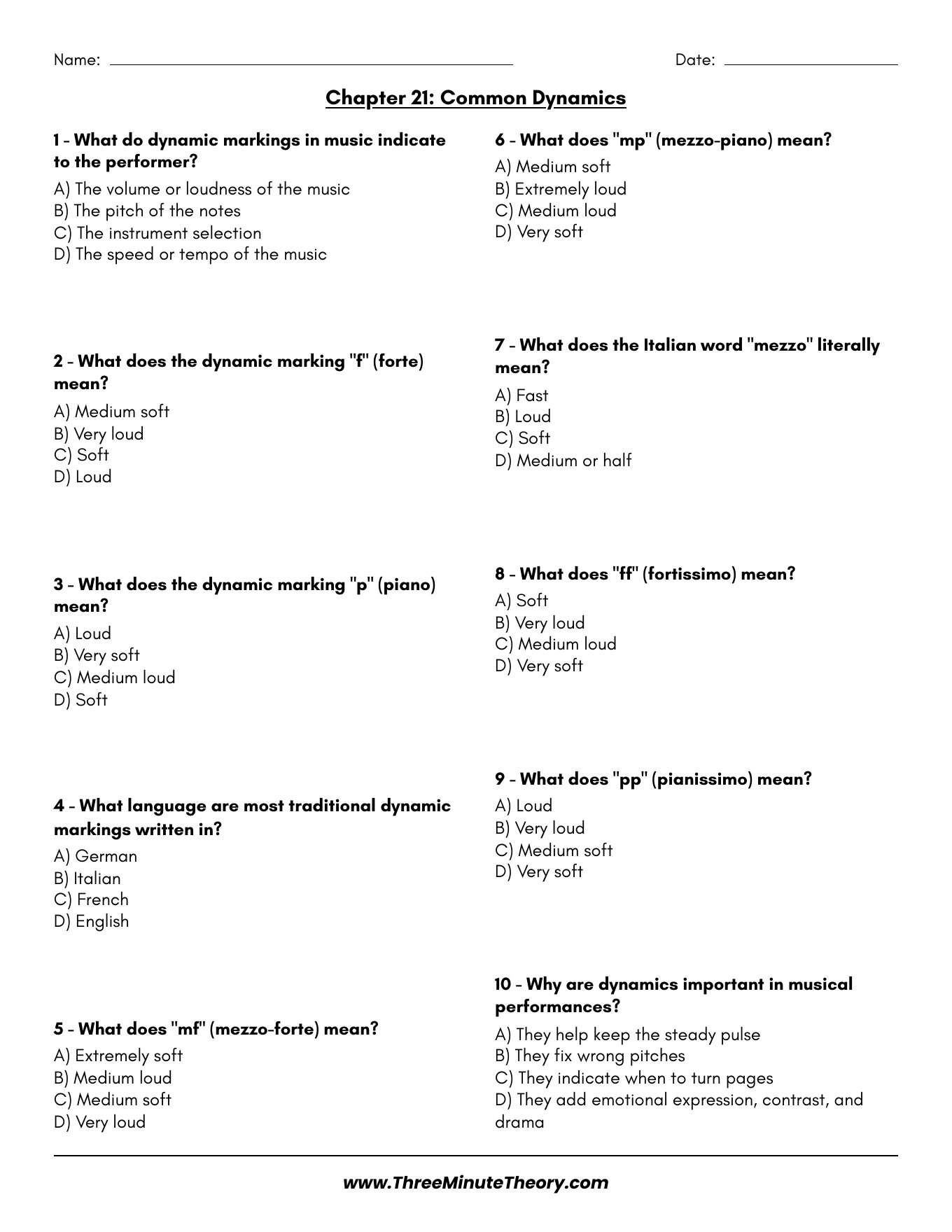
Teach this common set, from Chapter 21, Common Dynamics:
- pp (pianissimo): very soft
- p (piano): soft
- mp (mezzo-piano): medium soft
- mf (mezzo-forte): medium loud
- f (forte): loud
- ff (fortissimo): very loud
Two details help the abbreviations stick. Mezzo means medium, or half, which is why mf is a little softer than f, and mp is a little louder than p. Forte is Italian for strong, so f means play loud. Two f's (written ff) mean very loud.
Press play on Chapter 21 after warm-ups, then have everyone open the piece on the stand. Give them a short hunt: What is the softest marking on this page? What is the loudest? Then sing or play one phrase twice, once at p and once at f, so the definition turns into a sound.
2. Changing dynamics, then the fermata in the same chapter
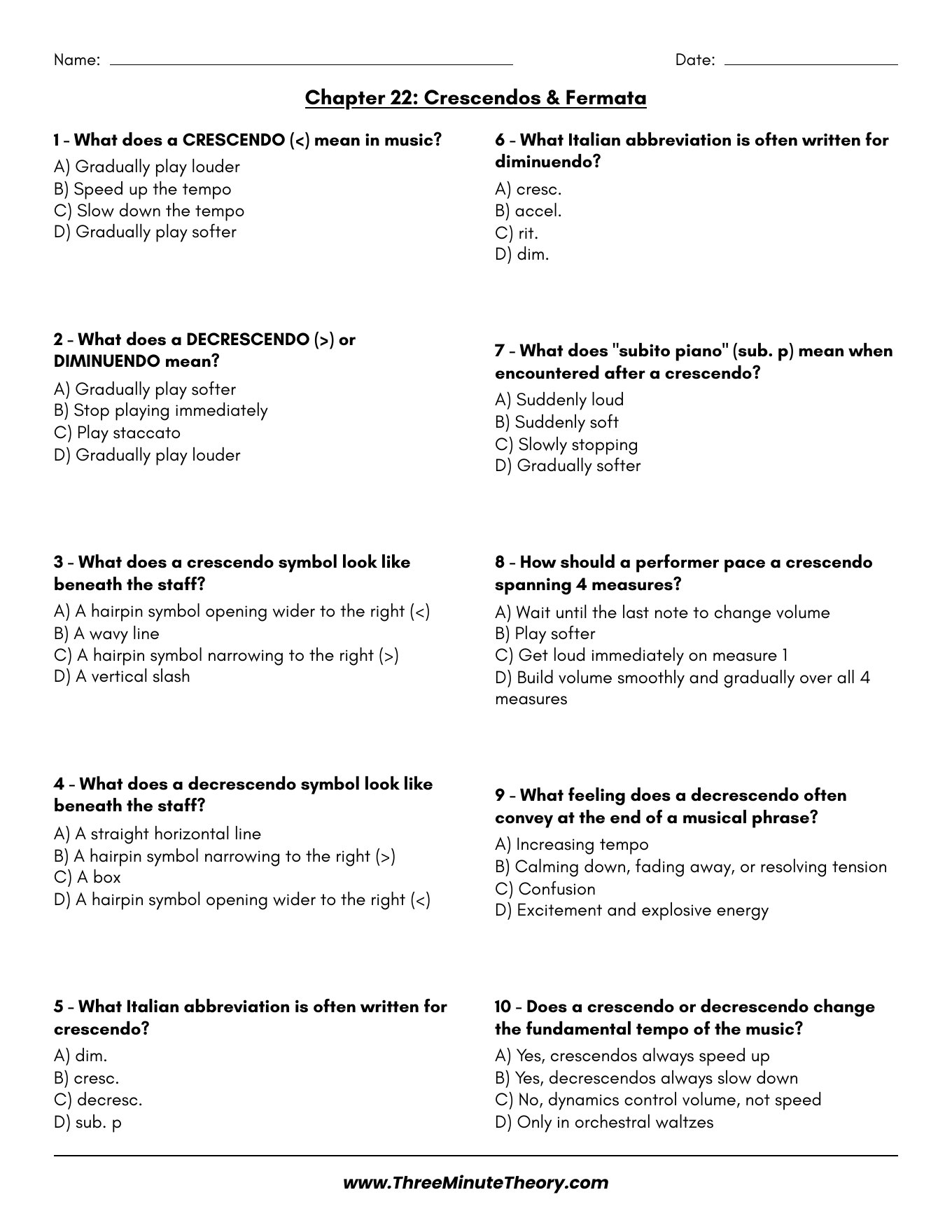
Once students can name p and f, they need to change volume over time. Chapter 22, Crescendos & Fermata, teaches that next.
- Crescendo (cresc.), often a hairpin that opens wider to the right (<): gradually play louder.
- Decrescendo or diminuendo (dim.), often a hairpin that narrows to the right (>): gradually play softer.
- Subito piano (sub. p): suddenly soft, often right after a crescendo.
A crescendo is Italian for growing. It tells students to get louder little by little, not all at once. If the marking lasts four measures, they should build smoothly across all four and arrive at the loudest point at the end. A crescendo or decrescendo changes volume, not speed. The tempo should stay steady unless a separate tempo marking says otherwise.
Chapter 22 also teaches the fermata, the curved arc over a dot that many musicians call a bird's eye. A fermata holds one note or rest longer than written. It does not make the note louder, and it does not add a fixed number of beats. In an ensemble, the conductor decides how long it lasts, and the group lets go together.
If you teach the crescendo on Tuesday, rehearse the big crescendo in the concert piece on Tuesday too. That is the transfer that makes the lesson worth the three minutes.
3. Tempo markings, then gradual changes in speed
Tempo is the speed or pace of the musical pulse. It does not change the pitch or the volume of the notes. Standard tempo markings are also written in Italian, and they usually sit above the staff at the start of the piece, then again wherever the tempo changes.
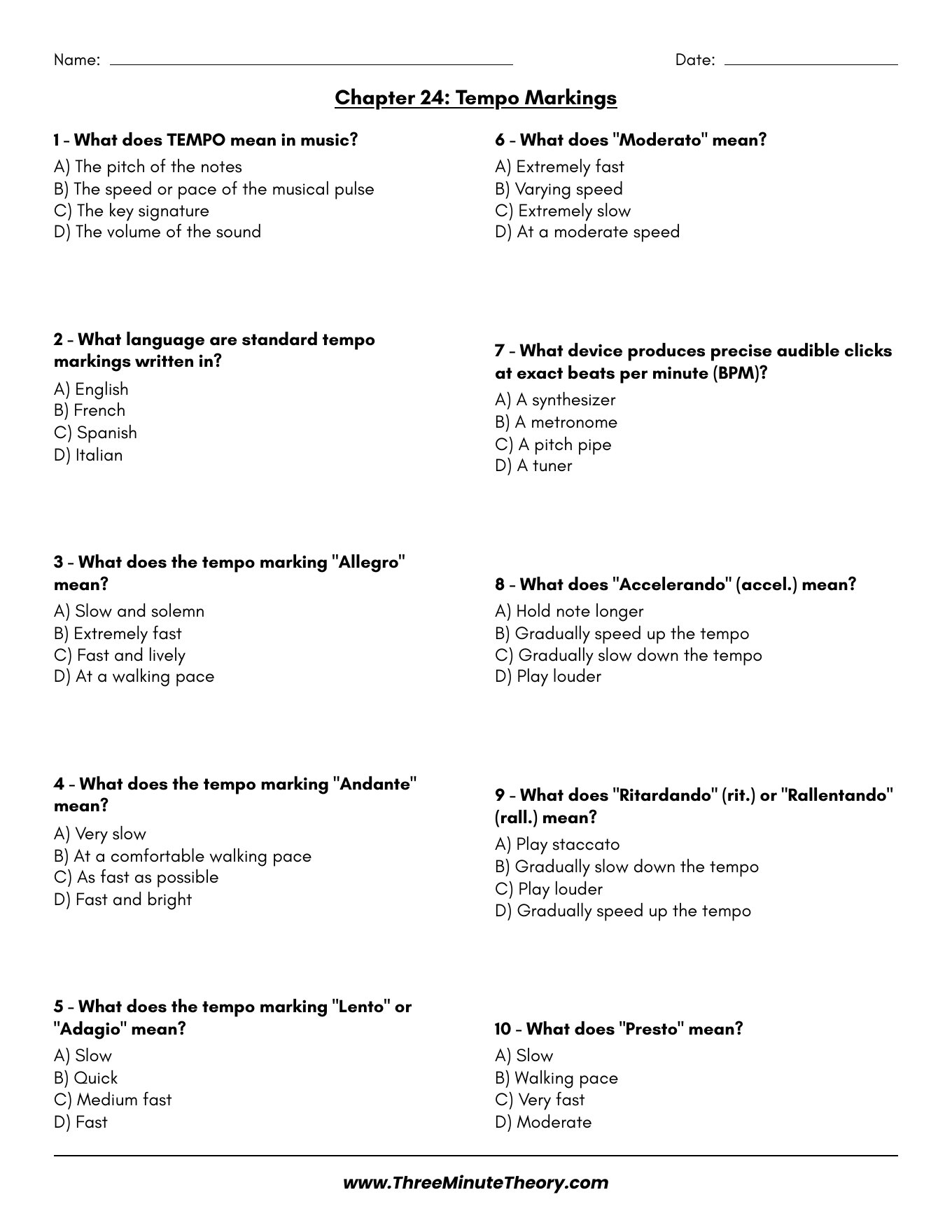
Common markings, from Chapter 24, Tempo Markings:
- Lento or Adagio: slow
- Andante: at a comfortable walking pace
- Moderato: at a moderate speed
- Allegro: fast and lively
- Presto: very fast
A useful slow-to-fast order is Largo (very slow), Adagio, Andante, Moderato, Allegro, Presto. Allegro is fast, but not as fast as Presto. Lento and Adagio are both slow. Grave is even slower. You do not need every label on day one. You need the marking at the top of this concert piece, named and felt.
A metronome clicks a steady beat at a set number of beats per minute (BPM) when you want a precise speed. More beats in each minute means a faster tempo. After the Chapter 24 lesson, have the class say the written tempo out loud, clap one phrase at that pace, then play or sing the opening.
Then teach the markings that change speed:
- Accelerando (accel.): gradually speed up the tempo.
- Ritardando (rit.) or rallentando (rall.): gradually slow down the tempo, like slowing a car to a stop.
- A tempo: go straight back to the tempo you had before the rit.
The key word in all three is gradual, except for a tempo, which returns to the earlier speed right away. A rit. at the end of a phrase is not the same thing as a decrescendo, even though students often do both at once unless you ask for one change at a time.
4. Less common dynamics, when the music asks for them
Once the common markings are solid, Chapter 29, Less Common Dynamics, adds markings that show up in more advanced middle school music: ppp (extremely soft), fff (extremely loud), sfz or sforzando (a sudden, strong accent on a single note), fp or fortepiano (attack loud, then drop immediately to soft), plus terms such as morendo and sotto voce. Dynamic markings like these are relative, not exact volumes. A marking such as ppp just means softer than pp, and players judge it by the music around it.
Teach these when they appear in the repertoire, not as a second vocabulary test. Articulation (Chapter 26, Staccato vs. Legato, and Chapter 30, Other Articulations) can wait for its own short week. If the pulse itself is shaky, ear training for band and orchestra and Chapter 36, Feeling the Pulse & Subdivision, are a better side path than adding more Italian words.
A Two-Week Rehearsal Routine
This plan uses a few minutes after warm-ups. It is built for choir, band, and orchestra, and it stays attached to the concert music.
Week 1: dynamics
- Days 1 and 2. Project Chapter 21. Students hunt p, mp, mf, and f in the folder, then perform one phrase at two different volumes.
- Day 3. Run a short TMT Trivia round on Chapter 21, or project two or three worksheet questions as a check. Read the explanation after each answer, then find the same marking in the piece.
- Days 4 and 5. Project Chapter 22. Rehearse the actual crescendo, decrescendo, or fermata in the concert music the same day. If a sub. p is written after a hairpin, practice the sudden drop on purpose.
Week 2: tempo
- Days 1 and 2. Project Chapter 24. Students name the tempo at the top of the score, clap the opening, and play or sing it at that speed. Use a metronome if the printed marking also has a BPM, or if the group cannot agree on the pace.
- Day 3. Find every rit., rall., accel., and a tempo in the piece. Practice one of them as a gradual change, then return to the first tempo when the page says to.
- Day 4. Play a short game on Chapter 24, or mix Chapter 21 and Chapter 24 if you want students to keep volume and speed in separate mental boxes.
- Day 5. Do a symbol hunt on page one of the concert piece, then perform the opening with the written volume and the written speed. A marking hunt also makes a good bell ringer. Two worksheet questions make a good exit ticket.
If the meter is also messy, fix that in a separate warm-up with how to teach time signatures in middle school band. Dynamics and tempo will feel easier once the pulse is clear.
Common Mistakes I Watch For
I look for these in the first two weeks, and I usually correct them in the music, not with a second lecture.
- Treating mf and f as the same volume. Have the group play or sing the same four measures twice and make the difference obvious.
- Speeding up on a crescendo, or slowing down on a decrescendo. Ask for one change at a time: "This hairpin changes volume only. Keep the beat steady."
- Jumping to the new volume on the first beat of a hairpin. Count the measures in the crescendo out loud, then decide together where the loudest or softest point actually is.
- Reading rit. as "get quieter," or reading dim. as "get slower." Put both markings on the board and ask which one changes speed and which one changes volume.
- Forgetting a tempo after a ritardando. Practice the slowdown, then the return, so the ending does not stay in the slower speed by habit.
- Skipping the Italian word and memorizing only the abbreviation. Say piano, p, and "soft" together, the same way you would say forte, f, and "loud."
Games and Checks That Keep Rehearsal Moving
On the teacher dashboard, open Music Games and browse By Game or By Chapter. Any game can play any chapter, so the same TMT Trivia or TMT Basketball game can review common dynamics on Monday and tempo markings on Tuesday. You can also mix up to three chapters in one assigned game when you want a short review set. For middle school, use Medium (middle school). Students can replay as often as they like, and their grade is their best accuracy.

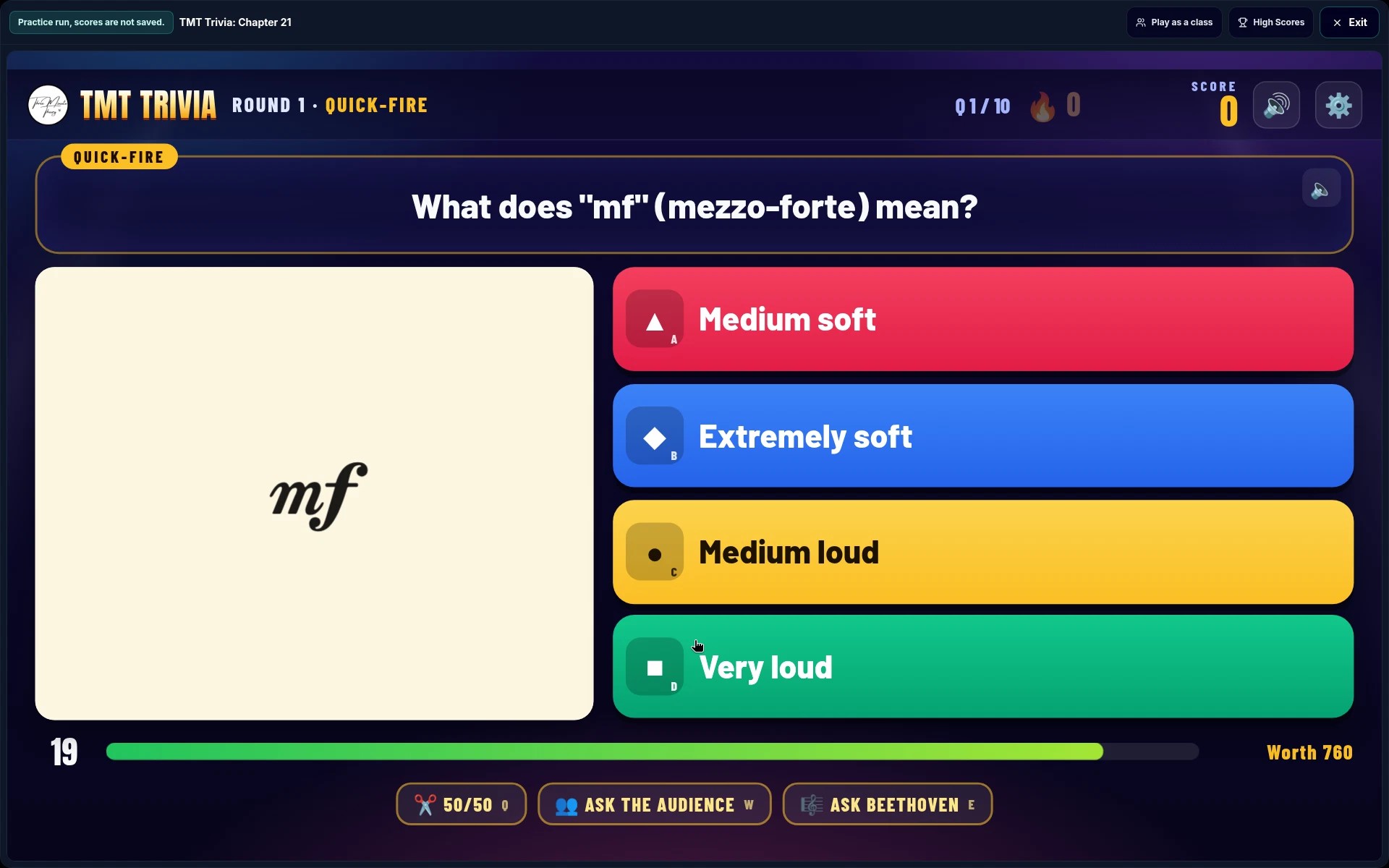
TMT Trivia is the game I use most on the projector after a 3-minute lesson. After each answer, Trivia shows a short explanation. That is what makes it a teaching tool and not only a quiz bowl. Read the explanation out loud, then have students find the same idea in their own music before the next question. A 10-question round is the right length for a middle school warm-up. For more on choosing a game and keeping it short, see music theory games for middle school.
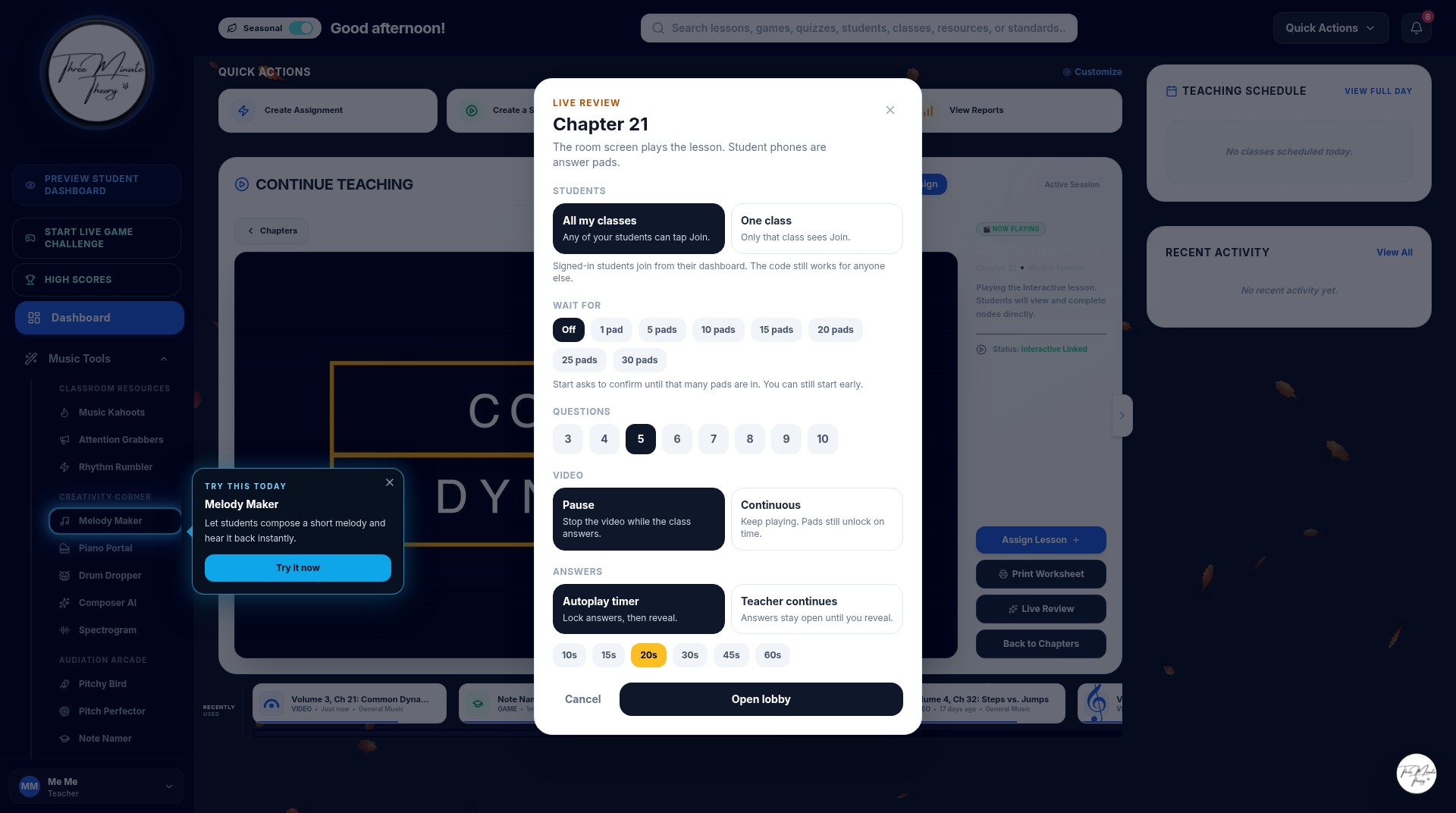
For a calmer check, use Live Review. The room screen plays the lesson, and student phones are answer pads. You choose 3 to 10 questions, and you can Pause the video while the class answers. Start Live Review on Chapter 21, 22, or 24 the same way you would start it on any other chapter.
If you want a written check, use the chapter worksheet or a short quiz from music theory assessments for middle school. On a stations day, the same chapters fit a game or worksheet station in music theory centers for middle school.
Choir, Band, and Orchestra Use the Same Markings
The core list is the same in every ensemble. What changes is how the marking is performed: breath, vowels, and diction in choir, tonguing and style in band, and bowing in orchestra. A choir piano still has to spin, a band forte still has to stay in tone, and an orchestra crescendo still has to move in the bow, but the printed instruction is the same.
For fitting a short theory habit to an octavo, see music theory for choir students. For strings, including the warm-up after tuning, see music theory for orchestra. Choir teachers who want the next step on sung style can add Chapter 88, Articulation & Diction, from The Choir Volume, after the common dynamics and tempo markings are secure.
Where This Fits in a Yearly Plan
In the music theory curriculum map, these chapters sit in Unit 3 (November to December): Symbols for the Winter Concert. That unit also includes Chapter 23, Repeat Symbols, Chapter 25, Following Your Part, Chapter 26, Staccato vs. Legato, Chapter 27, Phrasing, and Chapter 28, D.S. al Coda/Fine. The map's advice is practical: teach dynamics and repeat signs before the winter concert, not after it, and connect every concept to the music in the folder within a week.
If you already have a daily habit for key signatures or intervals, keep that habit and swap in Volume 3 for two weeks. The routine stays the same. Only the chapter changes.
Frequently Asked Questions
What is the difference between dynamics and tempo?
Dynamics tell a performer how loud or soft to play. Tempo is the speed or pace of the musical pulse. A crescendo or decrescendo changes volume, not speed, unless a separate tempo marking says otherwise.
How do you teach dynamics in middle school music?
Start with common dynamics (pp, p, mp, mf, f, and ff), project a short lesson, then have students find those markings in their concert music and perform one phrase the way the page asks. Teach changing dynamics (crescendo, decrescendo, and subito piano) next, and rehearse the actual hairpin in the piece the same day.
How do you teach tempo markings in middle school?
Teach the common Italian markings first (Lento or Adagio, Andante, Moderato, Allegro, and Presto), show where the marking sits above the first measure, and have the group clap or play the opening at that speed. Then teach gradual changes (accelerando, ritardando or rallentando, and a tempo) when they appear in the folder.
What dynamics should middle school students learn first?
Start with the common set from piano to forte, including mezzo-piano and mezzo-forte, plus pianissimo and fortissimo. Add less common markings such as sforzando, fortepiano, ppp, and fff when they show up in the repertoire, not as a second vocabulary test.
Does a crescendo change the tempo?
No. Crescendos and decrescendos only change how loud you play. The tempo should stay steady unless a marking such as accelerando or ritardando says otherwise.
Start Tomorrow
Pick the piece on the stand, project Chapter 21 or Chapter 24, and have students name one marking, find it in the music, and perform it. That is three minutes, and it is the start of the habit. If you want a two-minute check at the end of class, see music theory exit tickets. A symbol hunt also makes a good bell ringer.
If you want the lessons, games, Live Review, and worksheets above ready to go, take a look at Three Minute Theory for choir, band, and orchestra, or try Three Minute Theory free for 7 days at ThreeMinuteTheory.com. A Teacher License is $39 a month or $349 a year. When your ensemble is ready to sight-read those same markings in new music, try SightReadQuest. And for more classroom ideas from founder Matthew Gawronski, visit MatthewGawronski.com.