Music Theory Curriculum Map
A unit-by-unit music theory map for middle school choir, band, and orchestra, built on a few minutes of theory every rehearsal.
Most music theory curriculum plans are written for a theory class that meets for 50 minutes a day. That is not most of us. If you teach middle school choir, band, or orchestra, theory has to fit around warm-ups, concert music, and the fire drill that always lands on your rehearsal day.
Theory still does not have to be random. A simple curriculum map, built on a few minutes of theory every day, can carry a sixth grader from "Which line is G?" to reading a festival sight-reading piece by May. This post lays out that map unit by unit, with notes for each ensemble and the Three Minute Theory chapters and games that line up with each step.
What a Curriculum Map Needs to Do in an Ensemble Class
A map for a performing ensemble has a different job than one for a theory elective. It should meet five tests:
- It fits in a small, daily slot. Three to five minutes, every rehearsal, at the same point in class.
- It follows the concert calendar. Teach dynamics and repeat signs before the winter concert, not after it.
- It spirals. Students see note names in September, again with key signatures in January, and again when they sight-read in April.
- It works for every ensemble. The core is the same for choir, band, and orchestra. Each group gets a few add-ons of its own.
- It connects to the music in their folders. Every concept should show up in real repertoire within a week.
The Daily Routine That Holds the Map Together
The map only works if the daily routine is boring in the best way. Here is the routine I recommend:
- Minute 1 to 3: the lesson. One short concept, taught clearly.
- Minute 3 to 4: a quick check. Two or three questions, a thumbs up, or a short game round.
- Minute 4 to 5: find it in the music. "Find a dotted quarter note in measure 12." Then play or sing it.
In Three Minute Theory, each lesson is a video of about three minutes, so you press play right after warm-ups (or after tuning, for strings). When a student picks a wrong answer, a short 30-to-60-second video explains that idea again before they move on. You can run a lesson in Live mode, where you control it for the whole class, or in Independent mode, where students work at their own pace on their own devices. Both modes track completion and send scores to your gradebook.
A Middle School Music Theory Scope and Sequence, Unit by Unit
Here is a school-year map in eight units, assuming a late August or early September start. Each unit lists the focus, the matching Three Minute Theory chapters, and a quick check.
Unit 1 (August to September): The Staff and Reading Your Part
Focus: the staff, treble and bass clef, measures and systems, time signatures, and reading notes in your clef.
Three Minute Theory chapters: Chapter 1 (Treble Clef vs. Bass Clef and the Musical Staff), Chapter 2 (Measures, Systems, and How to Follow Your Part), Chapter 3 (Time Signatures), Chapter 4 (Reading Treble Clef Notes), and Chapter 5 (Reading Bass Clef Notes).
Quick check: Point to a measure in their music and ask, "What is the first note? What beat does it start on?"
Do not skip this with eighth graders. A two-week refresh in September saves a lot of "Where are we?" in October.
Unit 2 (October): Rhythm Foundations
Focus: quarter, half, and whole notes, counting out loud, eighth notes, dotted rhythms, and rests.
Three Minute Theory chapters: Chapters 11 to 15 (Quarter Notes and Time Signature Review; Half Notes, Whole Notes, and Counting Rhythms; Eighth Notes; Dotted Rhythms; Rests).
Quick check: Write one measure on the board. Students count it out loud, then clap it, then play or sing it on one pitch.
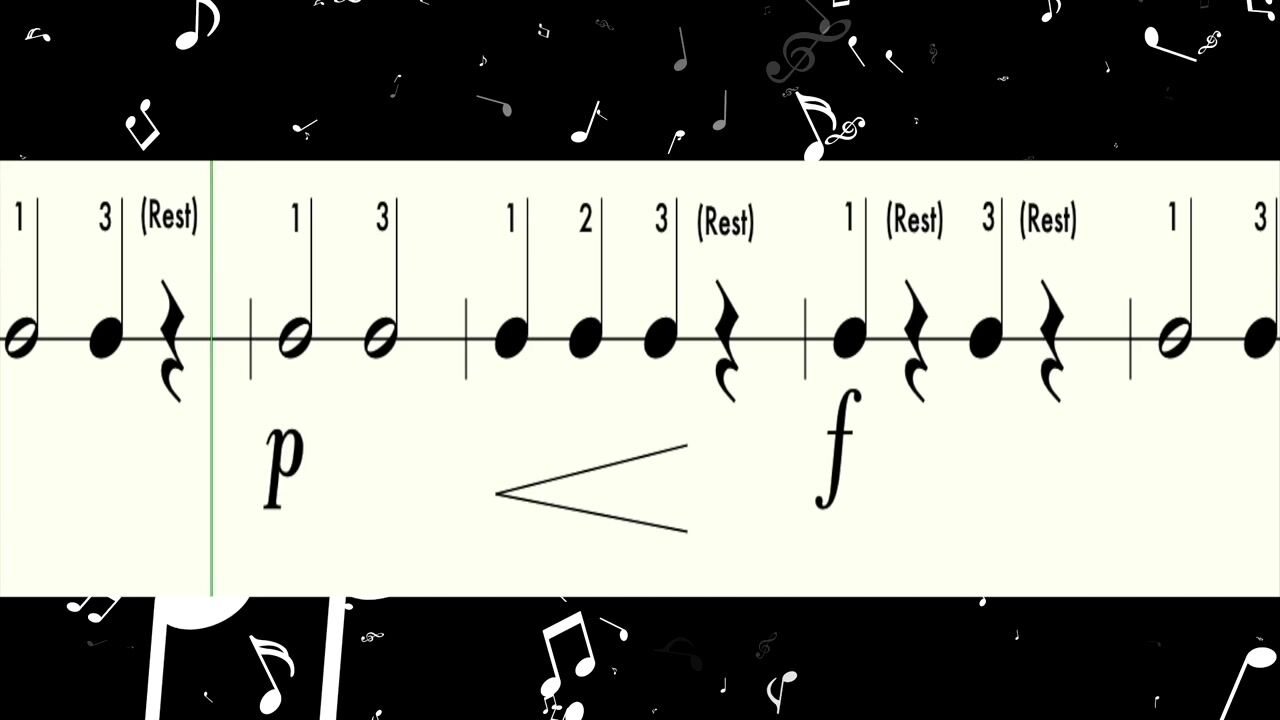
This is a great month to add a projected rhythm warm-up. Three Minute Theory includes Rhythm Rumbler, a set of 30 rhythm reading levels you can project for the whole class to clap and play. In the first round of each level, the counts are written above the notes. Later rounds take the counts away, so students have to read on their own.
Unit 3 (November to December): Symbols for the Winter Concert
Focus: the markings students will see on their concert music.
Three Minute Theory chapters: Chapter 21 (Common Dynamics), Chapter 22 (Crescendos and Fermata), Chapter 23 (Repeat Symbols), Chapter 24 (Tempo Markings), Chapter 25 (Following Your Part), Chapter 26 (Staccato vs. Legato), Chapter 27 (Phrasing), and Chapter 28 (D.S. al Coda/Fine).
Quick check: "Symbol hunt." Give students 60 seconds to find and circle every dynamic marking on one page of their concert piece.
If you teach crescendos on Tuesday, rehearse the big crescendo in measure 40 on Tuesday too.
Unit 4 (January): Accidentals, Solfege, and Key Signatures
Focus: sharps, flats, and naturals, solfege, finding Do, reading key signatures, ledger lines, and whole steps vs. half steps.
Three Minute Theory chapters: Chapters 6 to 10 (Accidentals; Solfege Syllables and Intro to Key Signatures; Identifying Key Signatures, Rules for Finding Do; Ledger Lines and Solfege Review; Whole Steps vs. 1/2 Steps).
Quick check: Show a key signature and ask, "Where is Do?" Then have the group sing or play the first five notes of that scale.
Spring music usually brings new keys, so January is a good time for this unit.
Unit 5 (February): Deeper Rhythm
Focus: sixteenth notes, ties vs. slurs, 6/8 time, syncopation, and multi-measure rests.
Three Minute Theory chapters: Chapters 16 to 20 (Sixteenth Notes; Ties vs. Slurs; Rhythm in 6/8 Time; Syncopation; Multi-Measure Rests and Rhythm Review).
Quick check: Play or sing a measure two ways, once with a tie and once without. Students show one finger or two to tell you which one matches the page.
Unit 6 (March): Ear Training
Focus: pitch direction, steps vs. skips, hearing sharp vs. flat, feeling the pulse, and simple rhythm dictation.
Three Minute Theory chapters: pick from Volume 4, Ear Training. Chapter 31 (Half Steps and Pitch Direction), Chapter 32 (Steps vs. Jumps), Chapter 34 (Tuning: Sharp vs. Flat), Chapter 36 (Feeling the Pulse and Subdivision), and Chapter 37 (Hearing and Dictation Basic Rhythms) are a strong middle school set.
Quick check: Play two pitches. Students point up, down, or flat hand for the same note.
For more ideas, see our guide to ear training for band and orchestra in 3 minutes a day.
Unit 7 (April): Sight Reading Before Festival
Focus: a plan for reading something new: scan the key, the meter, and the tricky rhythms before you start, keep going after a mistake, and read as a group.
Three Minute Theory chapters: from the Sight Reading Volume, Chapter 91 (What Is Sight Reading and Why Does It Matter?), Chapter 92 (Before You Sight Read), Chapter 93 (How to Read Ahead), Chapter 94 (How to Find Musical Patterns), Chapter 95 (Recovering from Mistakes), and Chapter 98 (Ensemble Sight Reading).
Quick check: Put up eight new measures. Give students 30 seconds to scan, then read it once with no stopping.
If you want daily sight-reading practice with instant feedback, our sister app SightReadQuest lets students sing or play into a mic and see right and wrong notes on the staff as they go.
Unit 8 (May): Create and Connect
Focus: using everything they learned to make music, plus a look at where their ensemble came from.
Three Minute Theory chapters: Chapter 42 (Melody Creation) and Chapter 43 (What Is Harmony?) from Music Creation, and Chapter 58, 59, or 60 (The History of the Choir, the Orchestra, or the Band) from Music History.
Quick check: Students write a four-measure melody using only the notes and rhythms from this year. The Melody Maker tool in Three Minute Theory lets them build it and hear it played back right away.
Adjusting the Map for Choir, Band, and Orchestra
The units above are the shared core. Here is how to tune them for each group.
Choir
Add one lesson a month from The Choir Volume (Chapters 81 to 90). Breath Control fits well in Unit 1, How to Read a Choral Score fits Unit 1 or Unit 3, How to Find Do pairs perfectly with Unit 4, and Vocal Intonation is a strong match for Unit 6. Lean on solfege all year, not just in January.
Band
Teach both clefs in Unit 1, since your low brass and bassoons read bass clef. When you talk pitch, use concert pitch ("concert F") and let each student find their own note. Let percussion students take turns leading the counting.
Orchestra
Add Chapter 101, The Alto Clef, to Unit 1 for your violists, and keep cellos and basses in bass clef. In Unit 4, start with sharp keys (D, G, and A major), since that is where most string music lives in the first years.
How to Check Progress Without Losing Rehearsal
You do not need a weekly test to know where students are. Short, regular checks work better.
Review games by chapter. On the Three Minute Theory teacher dashboard, you can pick games By Game or By Chapter, and any game can play any chapter. That means the same basketball or soccer game can review Chapter 4 in September and Chapter 19 in February.

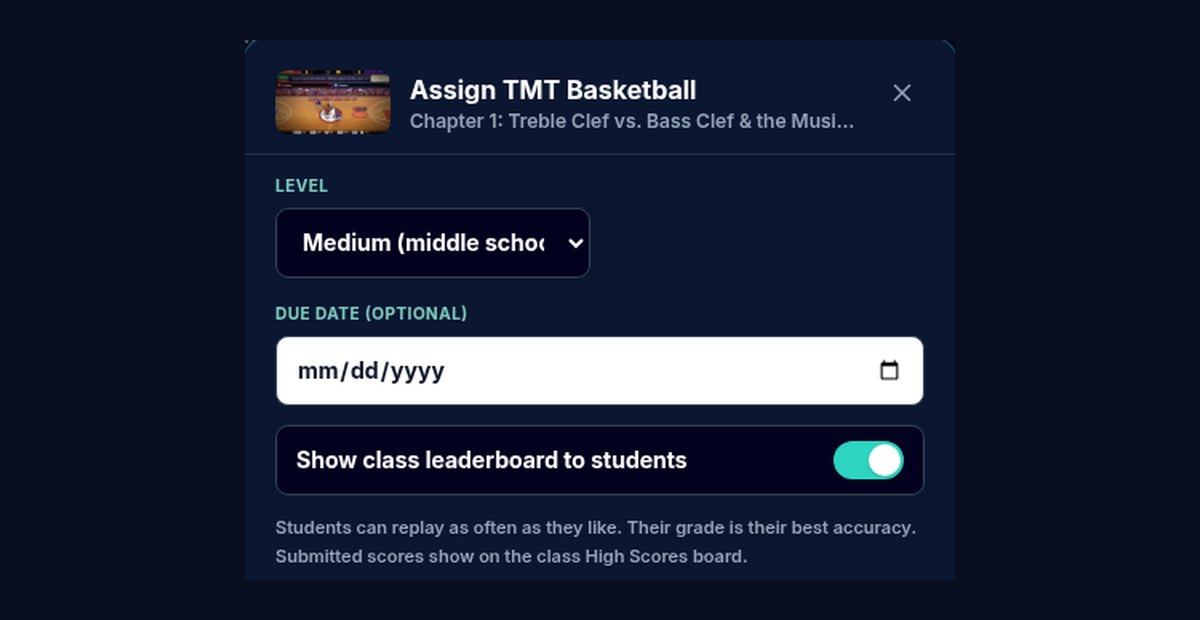
Assigned games with a level that fits. When you assign a game, you choose a level: Easy (elementary), Medium (middle school), or Hard (high school). You can add a due date and turn the class leaderboard on or off. Students can replay as often as they like, and their grade is their best accuracy.
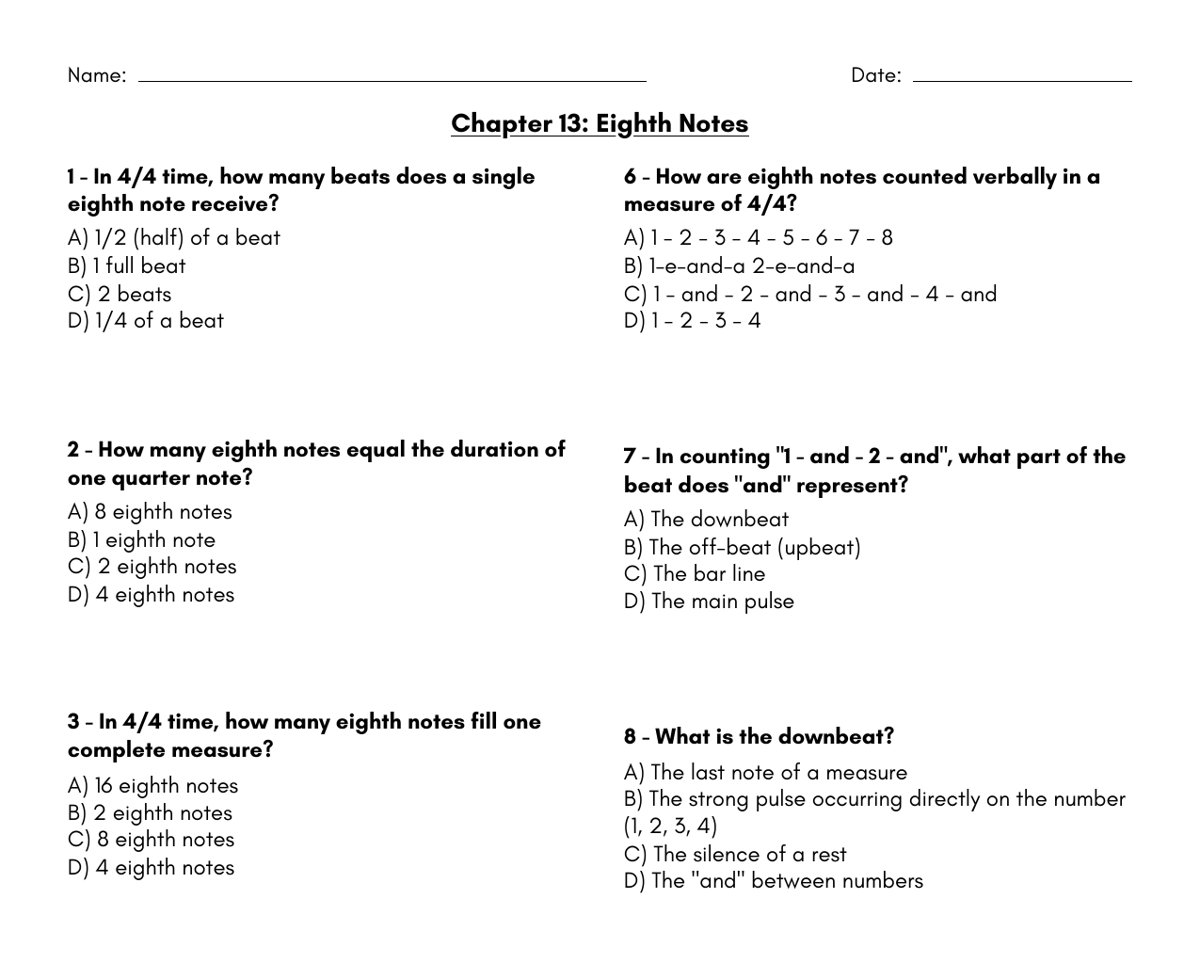
Printable chapter worksheets. Each chapter has a worksheet you can print for a sub day, a quick quiz, or students without devices. (During the free trial, printable PDFs stay locked.)
A Teaching Schedule. The Teaching Schedule links your class periods to Three Minute Theory content. Set it up once, and each day's lessons show up on your dashboard. That alone makes the map much easier to stick to.
Mixed Grades and Students Who Join Midyear
Many middle school ensembles mix grade levels. Start everyone at Chapter 1 in the fall. Eighth graders will move fast and feel confident, and sixth graders get the foundation they need. Use the game level setting to give older students a harder version of the same chapter.
When a new student joins in February, assign the early chapters in Independent mode so they can catch up a few minutes at a time while the class keeps moving.
Frequently Asked Questions
What should a middle school music theory curriculum include?
At minimum: reading notes in your clef, rhythm and counting, common musical symbols, key signatures, basic ear training, and sight reading. If time allows, add some composing and music history.
How many minutes a day should ensemble classes spend on theory?
Three to five minutes, every day, is enough. Doing it daily matters more than doing it for a long time.
Do sixth, seventh, and eighth grade need separate maps?
Not usually. One map with a spiral works well. Older students move through the early units faster, and the harder game levels keep them challenged.
What is a scope and sequence in music theory?
The scope is what you teach. The sequence is the order you teach it in. A curriculum map adds the timing, so you know which unit lands in which month.
Getting Started
Pencil in your concert dates, slide the units around them, and protect your daily slot.
If you want lessons, games, and worksheets already lined up in this order, you can try Three Minute Theory free for 7 days at ThreeMinuteTheory.com. There are pages for choir, band, and orchestra directors. And for more classroom ideas from founder and choir director Matthew Gawronski, visit MatthewGawronski.com.