How to Teach Key Signatures to Middle School Band (Without Losing Rehearsal Time)
How to teach key signatures to middle school band in short warm-ups: the sharp and flat rules, concert vs. written keys, common mistakes, and games that help.
Every band director has heard it. The clarinets play a beautiful B natural right where the key signature says B-flat, and half the section looks up like the music is wrong. Key signatures are one of those skills students "learn" in a worksheet and then forget the second their instrument is in their hands.
The good news is that you do not need a week of theory days to fix it. You need a clear rule, a few minutes a day, and a habit of connecting the rule to the music on the stand. This post covers how to teach key signatures to middle school band in short warm-up sized pieces, the mistakes I see most, and how I use Three Minute Theory lessons and games so the teaching fits inside rehearsal instead of replacing it.
Why Key Signatures Are Hard for Band Students
Most band students meet key signatures backwards. They learn fingerings for notes first, then later someone tells them that some of those notes are "always flat" because of a cluster of symbols at the start of the line. A few things make it harder than it needs to be:
- The key signature is easy to stop seeing. It sits at the start of every line, so the eye skips it like a page number.
- It applies to every octave. Students remember the B-flat on the third line, then play a B natural above the staff.
- Accidentals and key signatures follow different rules. An accidental lasts until the bar line. A key signature lasts the whole piece, or until a new key signature appears.
- Everyone in a band sees a different key signature. Your flutes and your trumpets are playing the same concert scale, but their parts do not look the same. More on that below.
So the goal is not just "name the key." The goal is that students look at the key signature, know which notes it changes, and actually play those notes.
What to Teach First
Here is the order that works for me. Each step is small enough to fit in one warm-up.
1. Sharps and flats change one note, everywhere
Start with accidentals. A sharp raises a note a half step, a flat lowers it a half step, and a natural cancels both. Then make the jump: a key signature is a set of sharps or flats that apply to every one of those notes, in every octave, for the whole piece. If the key signature has F-sharp, every F is F-sharp, high or low.
2. The order of sharps and flats
Sharps always appear in the same order: F, C, G, D, A, E, B. Flats are the same letters backwards: B, E, A, D, G, C, F. Many teachers use a sentence like "Father Charles Goes Down And Ends Battle" for sharps, and read it backwards for flats. Students do not need to memorize all seven on day one. They need to know that the order never changes, so a key signature with two flats is always B-flat and E-flat.
3. Two rules for finding the key
These are the rules I teach for major keys, and they match how Three Minute Theory teaches them:
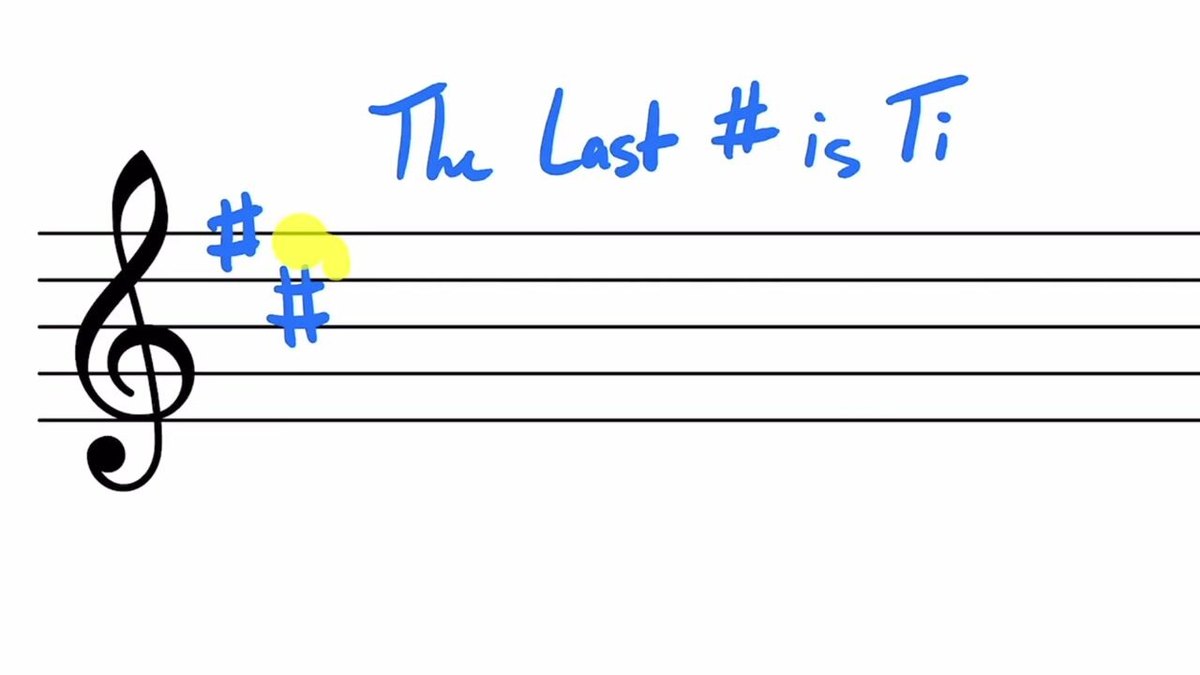
- Sharp keys: the last sharp (the one farthest to the right) is Ti. Go up a half step and you have Do, the name of the key. Two sharps, the last one is C-sharp, a half step up is D, so it is D major.
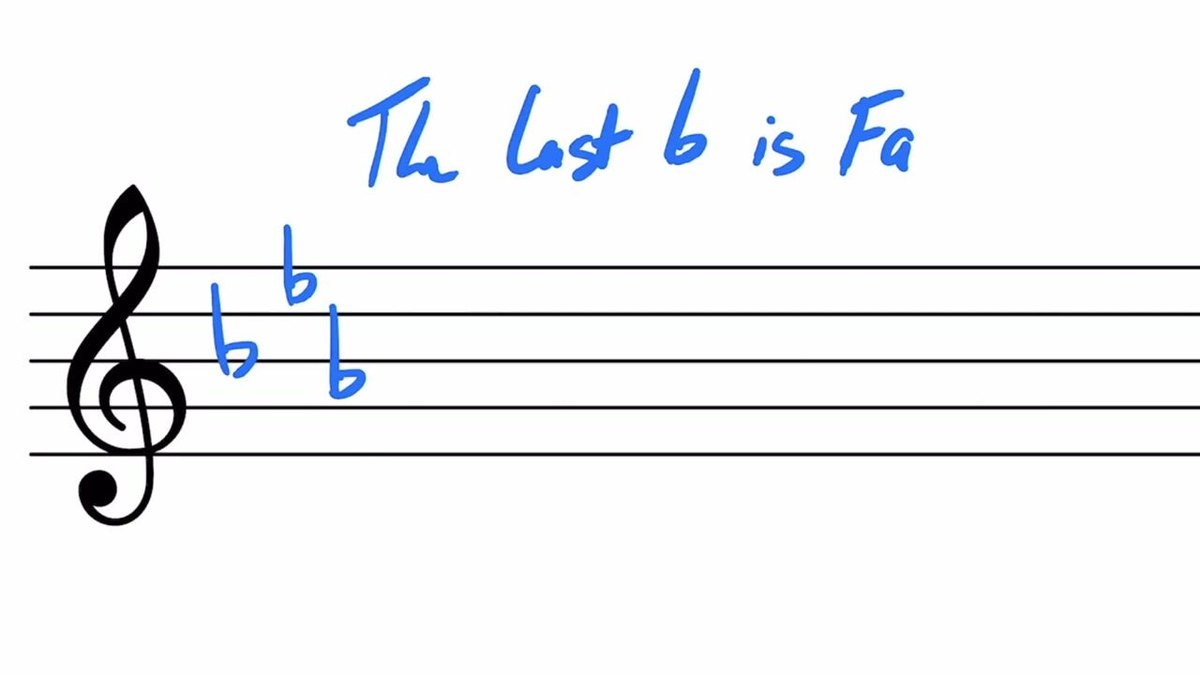
- Flat keys: the last flat is Fa. With two or more flats, the second-to-last flat is Do and names the key. Three flats are B-flat, E-flat, and A-flat. The second-to-last is E-flat, so it is E-flat major.
- Two to memorize: no sharps or flats is C major, and one flat is F major.
I like teaching the rules with solfege even in band, because "the last sharp is Ti" explains why the rule works. Ti always wants to go up to Do. Students who sing a scale in warm-ups feel that pull.
4. Connect it to the folder right away
The rule only sticks when students use it on real music. After a short lesson, have everyone open the piece you are rehearsing and answer three questions out loud: How many sharps or flats? Which notes do they change? Where is the first one of those notes in your part? Then play that measure.
Concert Pitch vs. Written Key Signatures
This is the part that confuses middle schoolers most, and it is worth one honest conversation. Transposing instruments read a different key signature than concert pitch instruments, even when the whole band is playing the same scale.
Take a concert B-flat major scale:
- Flute, oboe, bassoon, trombone, euphonium, tuba, and mallets read two flats (B-flat major).
- B-flat clarinet, bass clarinet, trumpet, and tenor saxophone read no sharps or flats (C major).
- Alto and baritone saxophone read one sharp (G major).
- French horn reads one flat (F major).
You do not need to teach transposition theory to sixth graders. You just need them to know that "concert B-flat" is the band's shared name, and that their own part might look different. The rule I give students is simple: always read the key signature on your own part, not your neighbor's. Then have each section name its written key out loud. It takes one minute and it clears up a lot of "but the trumpets don't have flats" questions.
A 3-Minute Key Signature Warm-Up Routine
Here is a two-week routine that fits right after your long tones or lip slurs. Each day takes about three minutes, then you go straight into the concert scale.
- Day 1: Short lesson on accidentals and how a key signature works. Play the concert scale and have students point to the altered notes on their part.
- Day 2: Order of sharps and flats. Quick game or call-and-response: "Two flats?" "B-flat, E-flat!"
- Day 3: The sharp rule. Show three sharp key signatures and have the band name each one before playing.
- Day 4: The flat rule. Same thing with flat keys.
- Day 5: Quick check. A short game or quiz. Note who still guesses.
- Days 6 to 10: One key signature question a day, always tied to the piece you are about to rehearse. Before you play, someone names the written key for their section.
The key is that the theory and the playing happen in the same five minutes. If students name the key and then immediately play a scale in it, the knowledge has somewhere to go.
Mistakes I See Most (and Quick Fixes)
- Naming the key but playing the wrong note. Fix: after naming the key, have students find the first altered note in their part and play just that measure.
- Forgetting the key signature in the upper octave. Fix: play the scale up an octave, or have students circle the altered notes above the staff in pencil.
- Using the last flat as the key name. Fix: repeat "the last flat is Fa" until it is automatic. Then count down Fa, Mi, Re, Do to land on the key name.
- Ignoring key changes. Fix: when a piece changes key, stop the band at the double bar, name the new key, and play the new scale before you rehearse the section.
- Mixing up accidentals and key signatures. Fix: quiz it directly. "An accidental lasts until when?" "The bar line." "A key signature lasts until when?" "The end of the piece, or a new key signature."
How Three Minute Theory Helps
Three Minute Theory is a sequential curriculum for choir, band, orchestra, and general music, built so each lesson takes about three minutes. That makes it easy to slide one in after warm-ups. Here is how I use it for key signatures.
The Lessons: Volume 1, Chapters 6 to 10
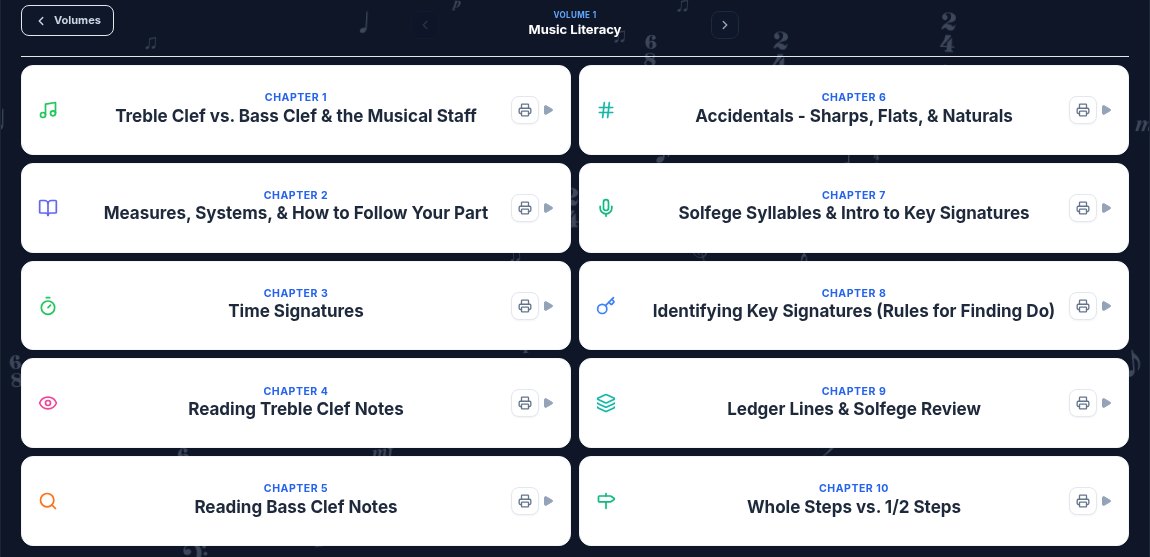
The key signature path lives in Volume 1, Music Literacy. Chapter 6 covers accidentals (sharps, flats, and naturals). Chapter 7 is Solfege Syllables and Intro to Key Signatures. Chapter 8 is Identifying Key Signatures (Rules for Finding Do), where the sharp and flat rules from this post come from. Chapters 9 and 10 follow with ledger lines and whole steps vs. half steps.
In rehearsal, I press play on the room screen, let the video teach the rule, and then go straight to the concert scale. Students do not need a login for you to project a lesson. If a student picks a wrong answer during an assigned lesson, a short 30 to 60 second video explains the idea again, so the reteaching happens without you stopping rehearsal.
Games for the Warm-Up
Every Three Minute Theory game can play any chapter, so you can run a game on Chapter 7 or Chapter 8 the same week you teach it. For a warm-up, I like TMT Trivia on the projector. The Quick-Fire round asks fast questions, and the key signature questions show the actual key signature on a staff, which is exactly the skill students need when they look at their part.
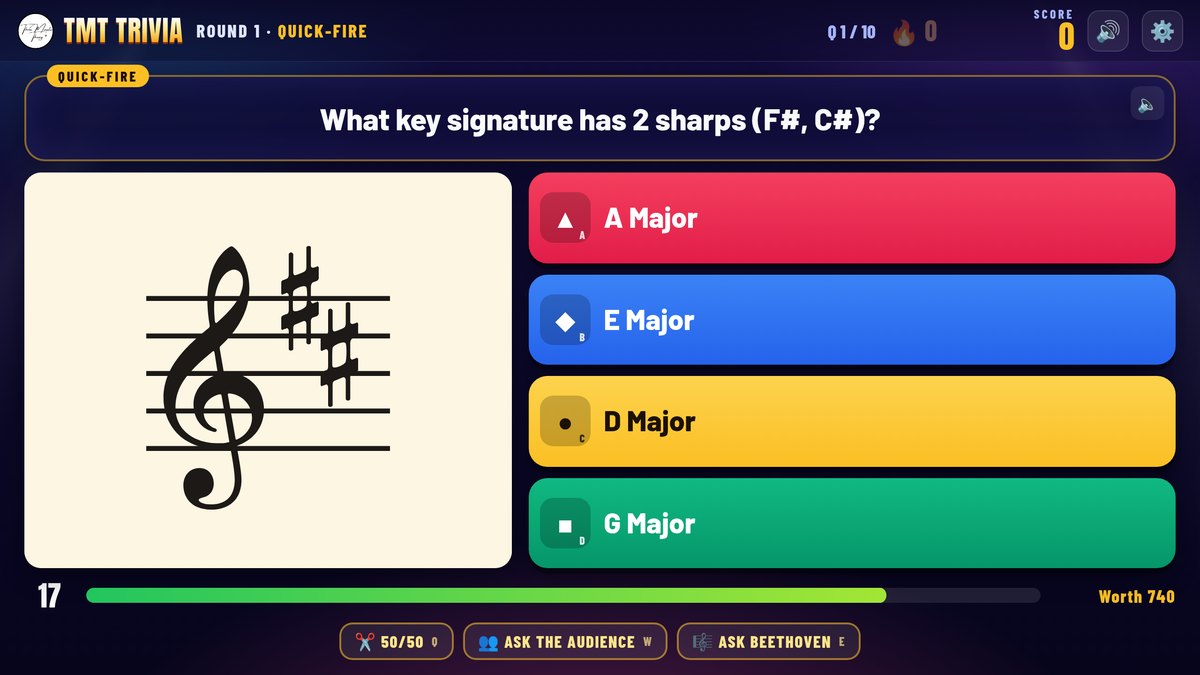
The Picture Reveal round uncovers a key signature a few tiles at a time, and the faster students name it, the more it pays. After each answer, Trivia shows a one-line explanation. That explanation is your teaching moment. Read it out loud, then have the band play the scale for that key.
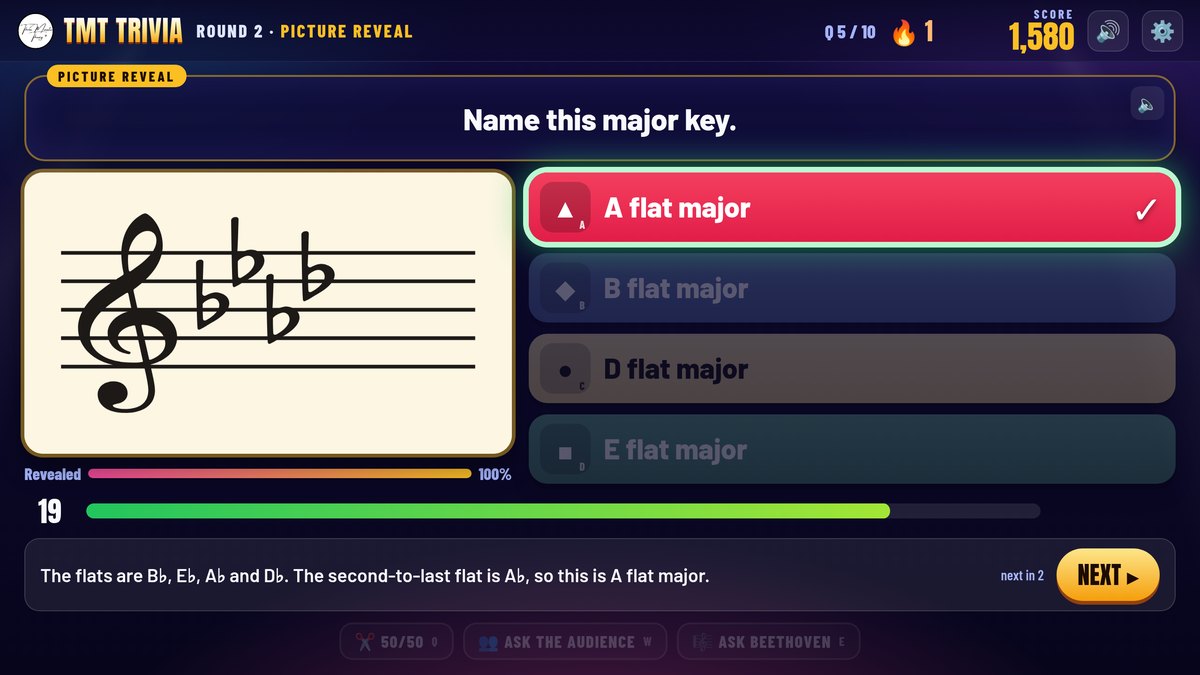
If your students have devices, TMT Trivia also has a Play as a class mode. The game runs on the room screen while students answer on their own devices, and you can save the scores to your gradebook at the end. Students need to be signed in to join.
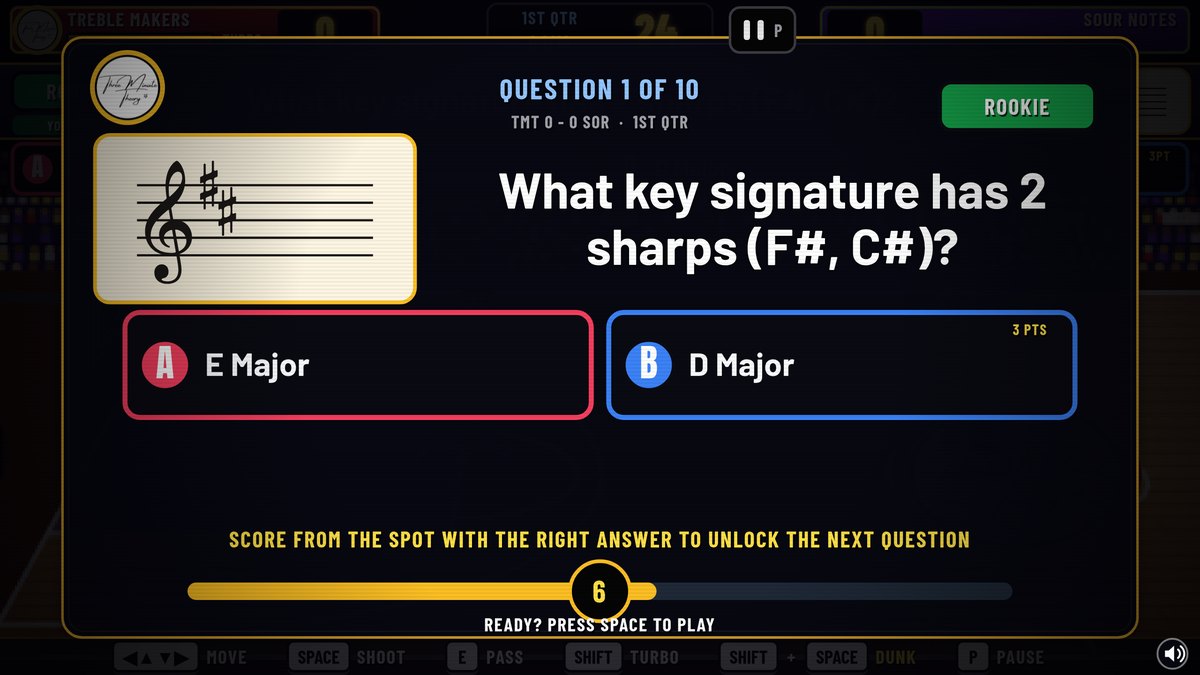
For a different feel, try a sports game like TMT Basketball. Students score from the floor spot that matches the right answer to move on to the next question. It works well as a quick assigned review the night after a lesson.
Pitchy Bird: Put Do in Their Ears
Naming a key is half the job. The other half is hearing where home is. Pitchy Bird is a pitch-matching game in the Music Tools on the teacher dashboard. A student sings or plays into the microphone, and the bird flies in the lane that matches the pitch. Hold a pitch to ride its lane, and go quiet to glide down.
Three things make it useful for key signatures:
- All 12 major keys. Set it to the key your band just named in warm-up.
- Solfege lanes. In Lanes view, the lanes run from low Do to high Do, so "the last sharp is Ti" becomes a lane students can hear right below Do. You can label the lanes with solfege, pitch names, or both.
- A staff view. Staff view shows the key signature on a staff in the clef for the voice or instrument you pick, like bass clef for trombone and tuba or treble clef for flute and trumpet.
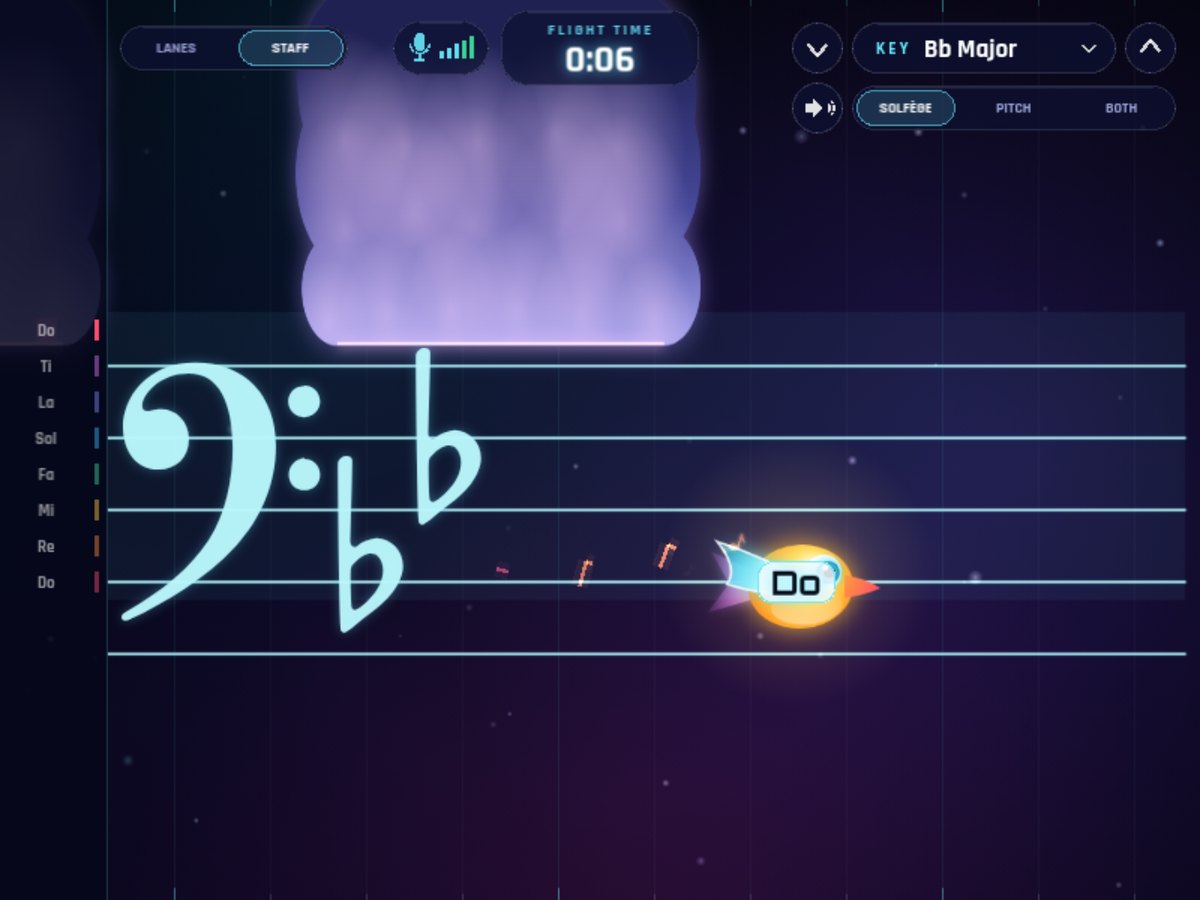
Here is how I use it. On Day 3 or Day 4, after the band names a key, I set Pitchy Bird to that key in Staff view. One volunteer flies the bird up the scale from Do to Do while everyone else watches the staff, and then the whole band plays the scale. It takes about two minutes, and now the key signature has a sound attached to it.
Watch Matthew play it live on YouTube (recorded in 2025, so a few screens look different now): Pitchy Bird Music Education Game Live Demo
If you want more ideas for training your players' ears, our post on ear training for band and orchestra has plenty that fit a warm-up.
Assign, Mix, and Check
When you assign a game, you pick a level (Easy, Medium, or Hard), an optional due date, and whether students can see the class leaderboard. Students can replay as often as they like, and their grade is their best accuracy. You can also mix up to three chapters in one game, so a review on Chapters 6, 7, and 8 together is one assignment.
After students play, the assignment page shows how each question went: from each student's first try, the share of students who got it right and how many picked each answer, with a Most missed view. If half your band picked "the last flat is the key name," you know exactly what to reteach tomorrow in warm-up.
Live Review for a Quick Check
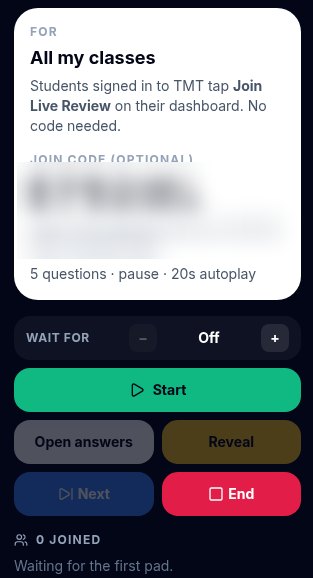
On Day 5, Live Review is a nice way to check the whole band at once. Open Chapter 8 and choose Live Review. The lesson plays on the room screen, and student phones become answer pads. In the setup, you choose whether all your classes or just one class can join, how many pads to wait for before you start, and 3 to 10 questions. You also decide whether the video pauses while students answer, and whether answers lock on a timer or stay open until you reveal them.
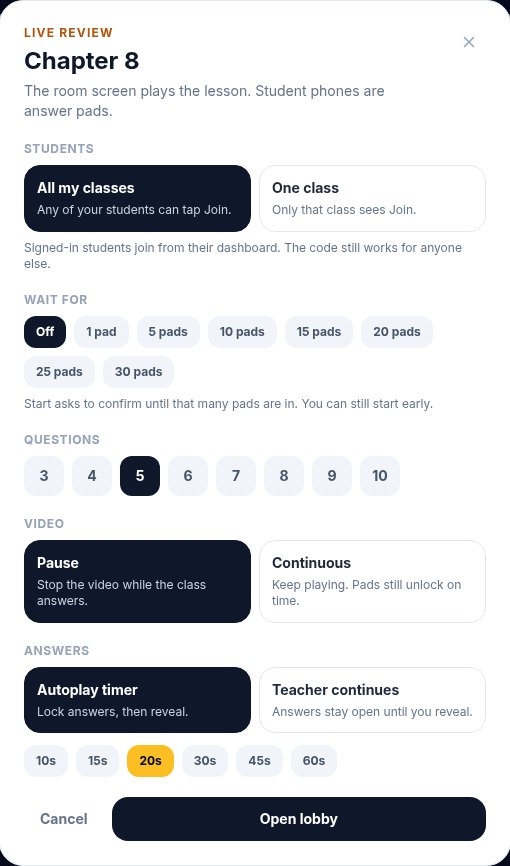
Then you open the lobby. Signed-in students tap Join Live Review on their dashboard, so there is no code to read out, and a join code still works for anyone else. You can see how many pads have joined, and when you are ready, press Start. At the end, you can save the scores to the gradebook. It is a lot faster than collecting a paper quiz from 60 players.
A Ready-Made Key Signature Quiz
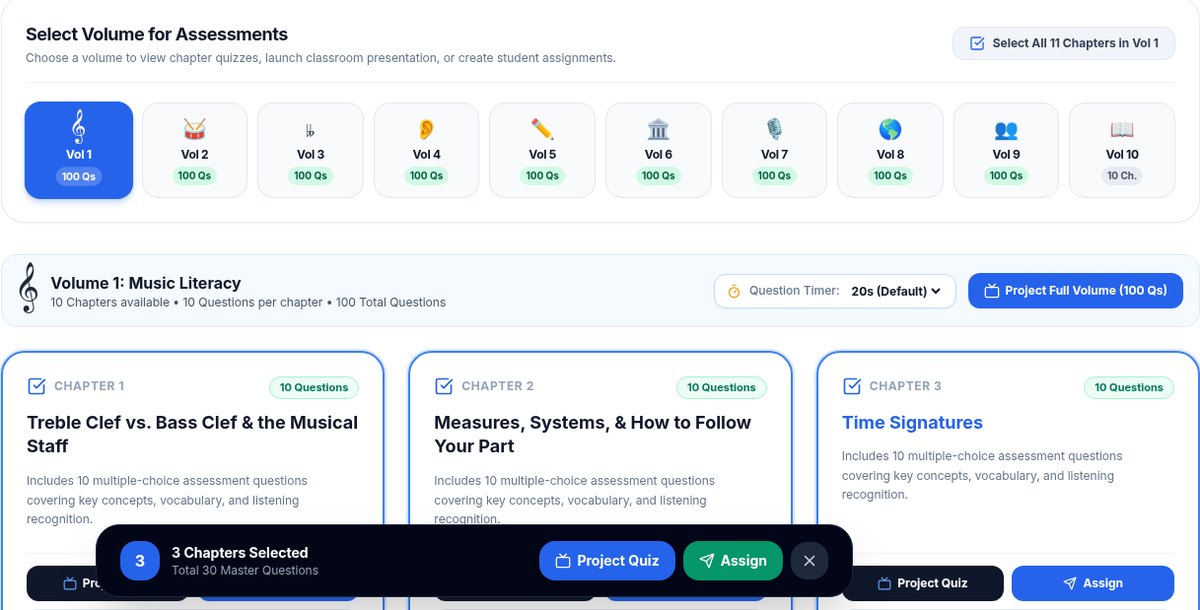
If you would rather give a short quiz, the Assessments page has 10 multiple-choice questions for each chapter in Volumes 1 to 9. Click the chapters you want, and a tray shows how many chapters and questions you picked, with buttons to project the quiz on the room screen or assign it. For key signatures, select Chapters 6, 7, and 8 for a 30-question check. When you project it, you can set a question timer.
Frequently Asked Questions
How long does it take to teach key signatures to a middle school band?
The rules themselves can be taught in a few short lessons. Making them automatic takes longer. If you spend about three minutes a day on key signatures for two weeks and keep connecting them to your concert music, most students can name common band keys and play the right altered notes.
Should band students learn key signatures in concert pitch or written pitch?
Teach students to read the key signature on their own part first, because that is what they play. Then teach the concert name as the band's shared language. A quick "name your written key" check by section clears up most confusion.
Should I teach the circle of fifths in middle school?
You can, but it is not where I start. The sharp and flat rules let students name a key from the page right away. Once they are comfortable with that, the circle of fifths is a nice way to show how the keys connect.
Where do key signatures fit in a yearly plan?
In our music theory curriculum map, key signatures sit in January, after the staff, rhythm, and symbols units. For band, I often start earlier, as soon as students are reading in more than one concert key.
Start Tomorrow
Pick one piece in your folder, name its key signature with your band before you play, and have each section say its written key. That is one minute, and it is the start of the habit. If you want more warm-up ideas, our music theory bell ringers and band rhythm games fit the same three-minute slot.
If you also teach choir, our post on music theory for choir students uses the same Find Do rules with your octavos. And if December is sneaking up on you, here are music theory activities for the week before winter break.
If you want the lessons and games above ready to go, take a look at Three Minute Theory for band directors (there is an orchestra page too), or try Three Minute Theory free for 7 days at ThreeMinuteTheory.com. When your band is ready to sight-read in those keys, try the 5-minute daily sight-reading routine for band from our sister app, SightReadQuest. And for more classroom ideas from founder Matthew Gawronski, visit MatthewGawronski.com.