Music Theory Quizzes for Band, Choir, and Orchestra That Don't Eat Rehearsal Time
Use Three Minute Theory chapter assessments and TMT AI quiz drafts to check one clear skill, collect useful answers, and keep time for rehearsal.
A music theory quiz should answer a teaching question: what can students read or explain on their own, and what needs another pass? It should not take the whole rehearsal to find out. A useful music theory assessment for middle school separates the skill being checked from the noise around it, such as device setup, unfamiliar directions, or a game score that includes bonuses.
Three Minute Theory gives teachers two starting points: ready-made chapter assessments in Assessments & Quizzes, and custom quiz creation through TMT AI. Use the chapter bank when the lesson already matches your goal. Use AI when the wording or focus needs tailoring, then check every question before giving it to students.
Here is a short assessment routine for band, choir, and orchestra, with specific examples you can adapt to the music you are teaching.
1. Choose One Skill Before Choosing a Quiz
"Music theory" is too broad for a quick check. "Students can identify the note on a treble-clef space" is narrow enough to teach and assess. Start with the matching Three Minute Theory chapter, such as Chapter 4, Reading Treble Clef Notes, Chapter 5, Reading Bass Clef Notes, or Chapter 3, Time Signatures.
Open Assessments & Quizzes and select the volume. For the written assessment bank in Volumes 1 to 9, regular chapters have ten multiple-choice questions. A full volume has 100. Those are different-sized jobs, so do not choose the full volume simply because the button is handy.
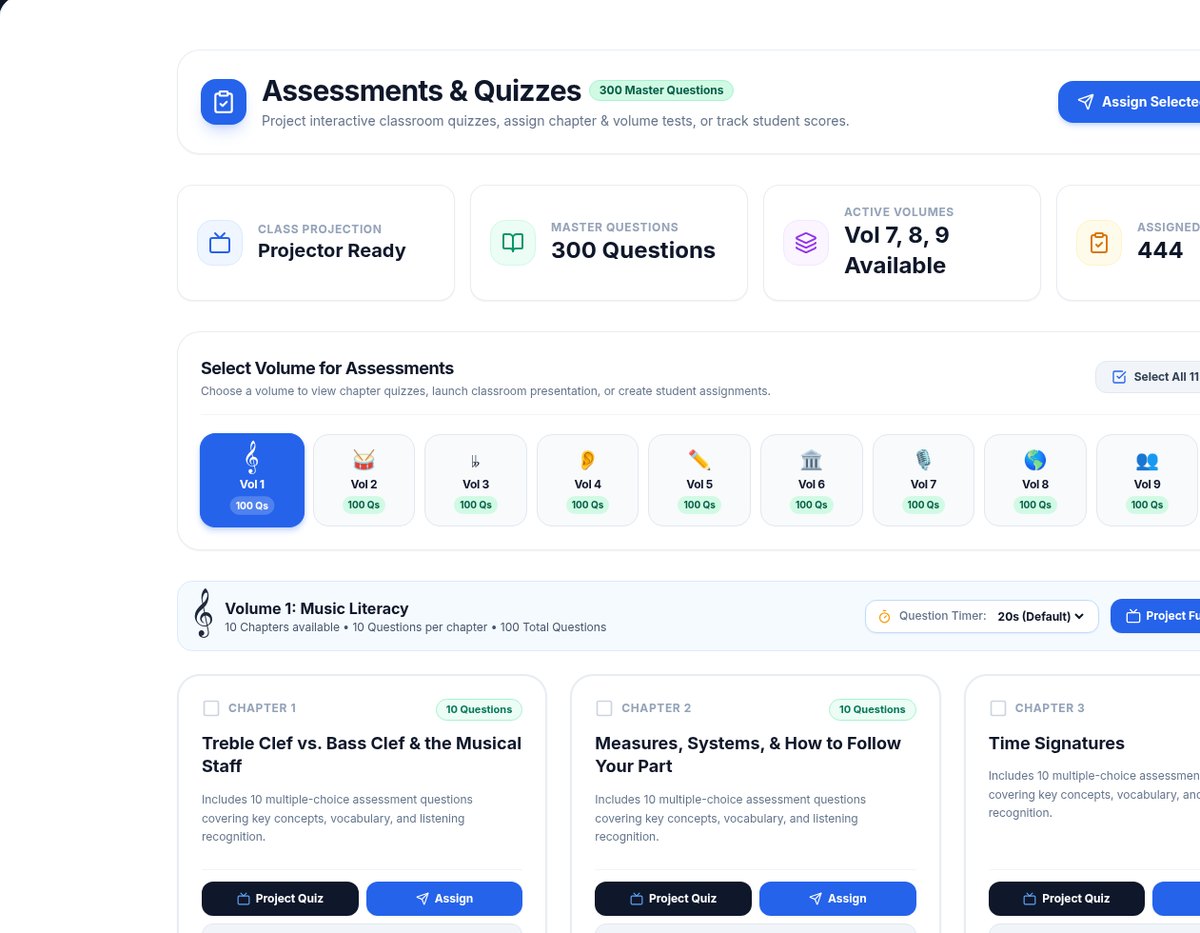
A ten-question chapter quiz is not automatically a three-minute activity. Allow time for reading, notation, and explanations. If you only have a brief opening, project a few questions for discussion and save the full assigned assessment for a longer slot. Call the short version a check, not proof that students have mastered the whole chapter.
2. Use Games to Prepare, Then Collect Individual Answers
TMT Trivia, Basketball, and Bowling give students another way to revisit a taught chapter. They are useful rehearsal warm-ups, but a team answer is not the same evidence as an individual answer. Keep practice and assessment distinct.
For Chapter 3, project a TMT Trivia question about the bottom number in a time signature. Ask students to choose silently, compare explanations with a neighbor, then read the answer explanation. After practice, use the chapter assessment to see what each student understands without the neighbor's help.
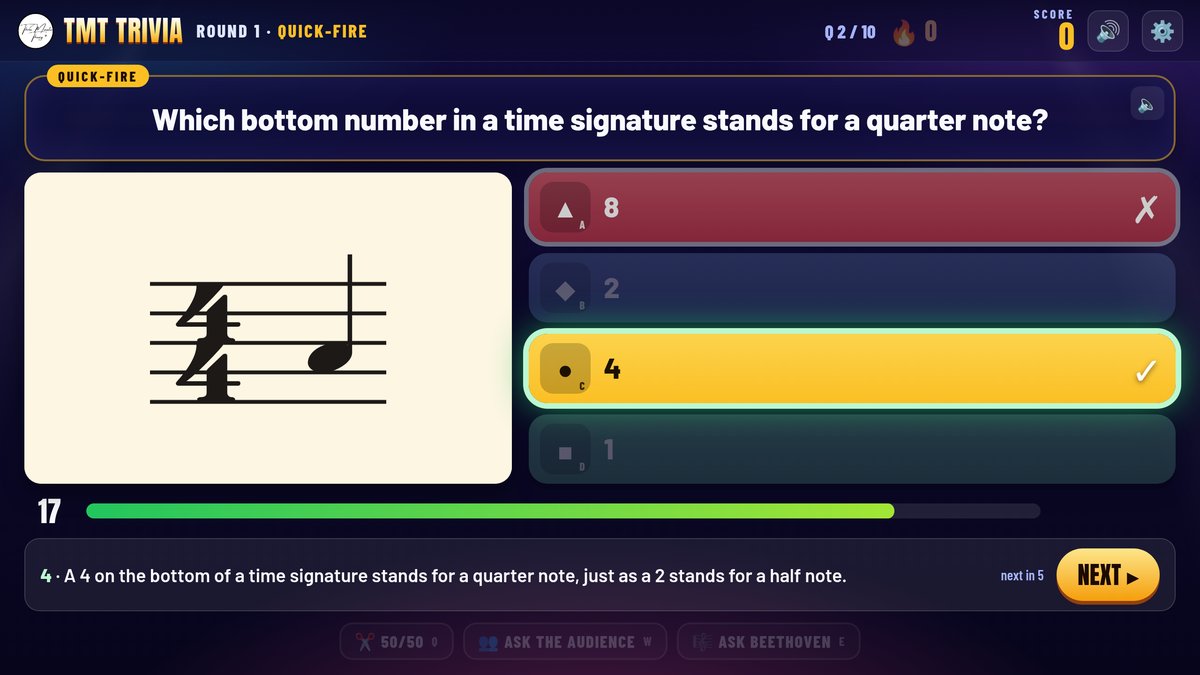
Choose whether today's task is practice or graded work before opening the game. Tell students which it is. Do not turn a fast, supported game round into a surprise grade after they finish. Our time-signature teaching guide gives a rehearsal sequence for this chapter.
3. Match the Assessment to the Ensemble
The same quiz does not always belong in every music class. Select chapters that match what students have been asked to read, sing, or play.
- Band: Chapter 4 or 5 for the clef students use, Chapter 3 for meter, and Chapter 8, Identifying Key Signatures (Rules for Finding Do), when key signatures are the focus.
- Choir: Chapter 85, How to Read a Choral Score, or Chapter 86, How to Find Do, connects theory to the octavo instead of testing unrelated notation.
- Orchestra: use Chapters 4 and 5 where appropriate, plus the lesson and Live Review route for bonus Chapter 101, The Alto Clef!. Do not assume the bonus lesson has a regular written volume-assessment bank; it is skipped in the written volume assessments.
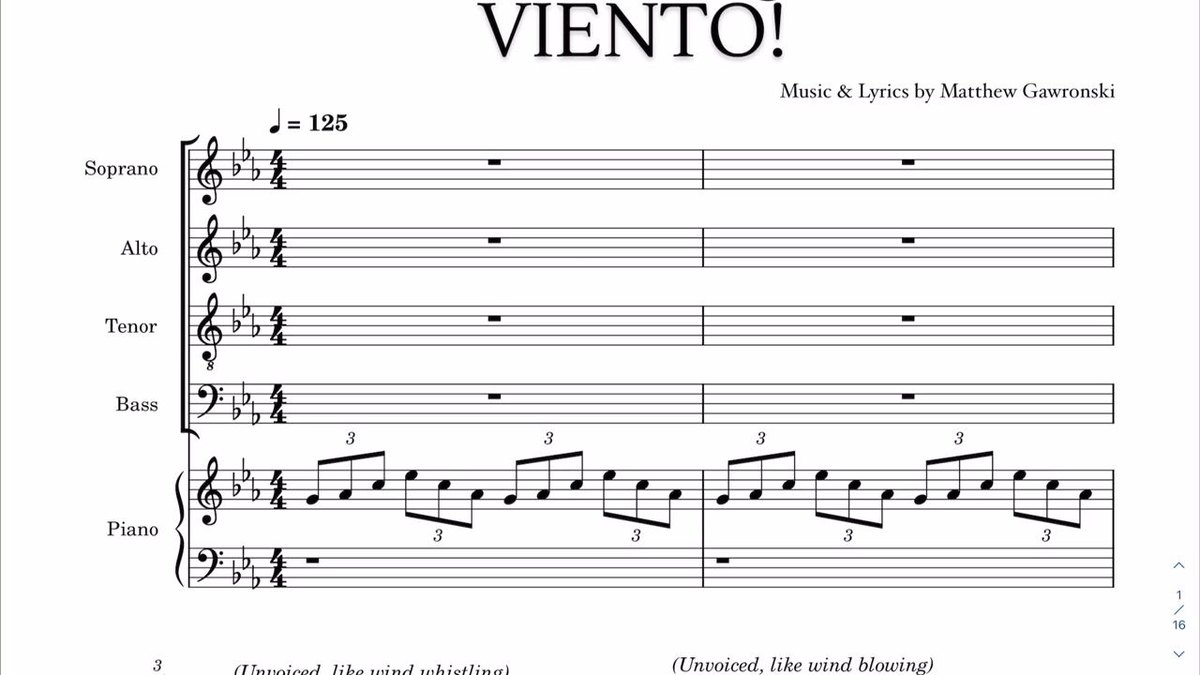
Use the quiz to check knowledge and a brief performance to check use. A student can identify a key signature correctly yet still miss its altered notes while playing. Ask for the written answer, then listen to the passage that depends on it. For strings, see music theory for orchestra; for singers, see music theory for choir students.
4. Combine Chapters Only When You Need a Unit Check
In Assessments & Quizzes, selecting more than one regular chapter opens a combined selection tray. Two ten-question chapters make a twenty-question assessment. That can be a useful unit check, but it is no longer the same-sized task as a single chapter.
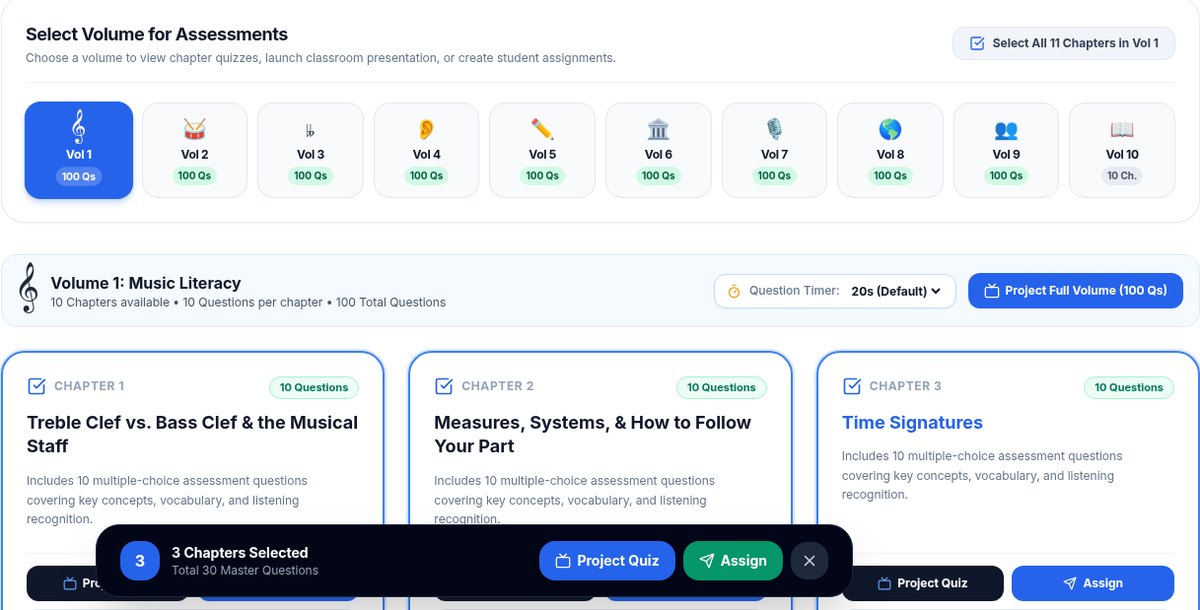
Preview the selected material first. For example, combine Chapter 3, Time Signatures, with Chapter 11, Quarter Notes/Time Signature Review, after both have been taught. Avoid adding a chapter just to make the test longer. A longer quiz does not solve an unclear teaching goal.
The question timer is adjustable in the projected quiz controls. Set a pace that gives students time to read the notation. If the goal is accurate identification, speed should not quietly become a second skill being graded.
5. Use TMT AI for a Custom Quiz, Then Check the Draft
Open TMT AI when you need custom wording or a narrower set of questions than the chapter bank provides. Its Quiz Generator can generate a custom Google Form quiz. Keep this separate from the ready-made TMT chapter assessment: do not assume an AI-generated Google Form automatically becomes a TMT assignment or shares the same scoring workflow.
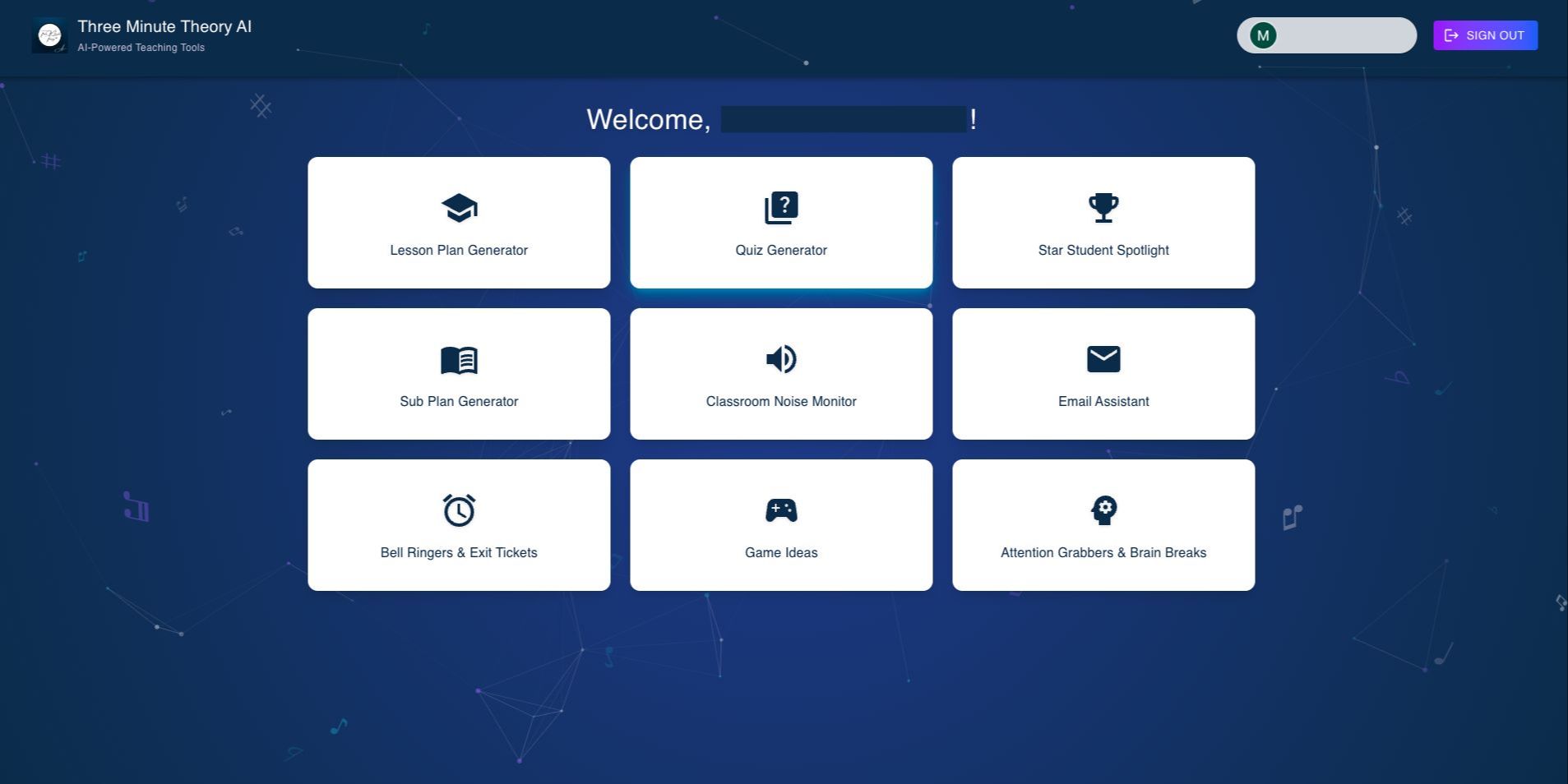
Here is a sample request to adapt, not a claim about a quiz already generated:
"Create a five-question middle school band quiz about the top and bottom numbers in simple time signatures. Use 2/4, 3/4, and 4/4. Include four multiple-choice items and one short explanation. Give an answer key. Avoid compound meter because we have not taught it yet."
Before using the result, check each answer, the reading level, and whether the question actually measures the stated skill. Watch for ambiguous wording such as "Which note gets the beat?" without a time signature. If the draft refers to notation that is not displayed, add a clear example yourself or replace the item. Do not assume AI has supplied accurate staff images.
Do not put student names, grades, or other private student details into a quiz-generation request. You can describe the class's learning need without identifying anyone. Keep the teacher's judgment between the generated draft and the student.
6. Use the Results to Pick the Next Lesson
After the quiz, sort errors by the concept behind them. In Chapter 3, a student who confuses the top and bottom numbers needs a different explanation from a student who knows both numbers but cannot keep the pulse. Reopen the relevant lesson rather than assigning a larger mixed quiz as a first response.
For absent students or a planned follow-up, the Create New Assignment builder lets you choose the music content and the class. Use the actual chapter assessment when you want quiz answers; use the lesson when the student needs teaching first. Check the task type and due date before assigning anything.
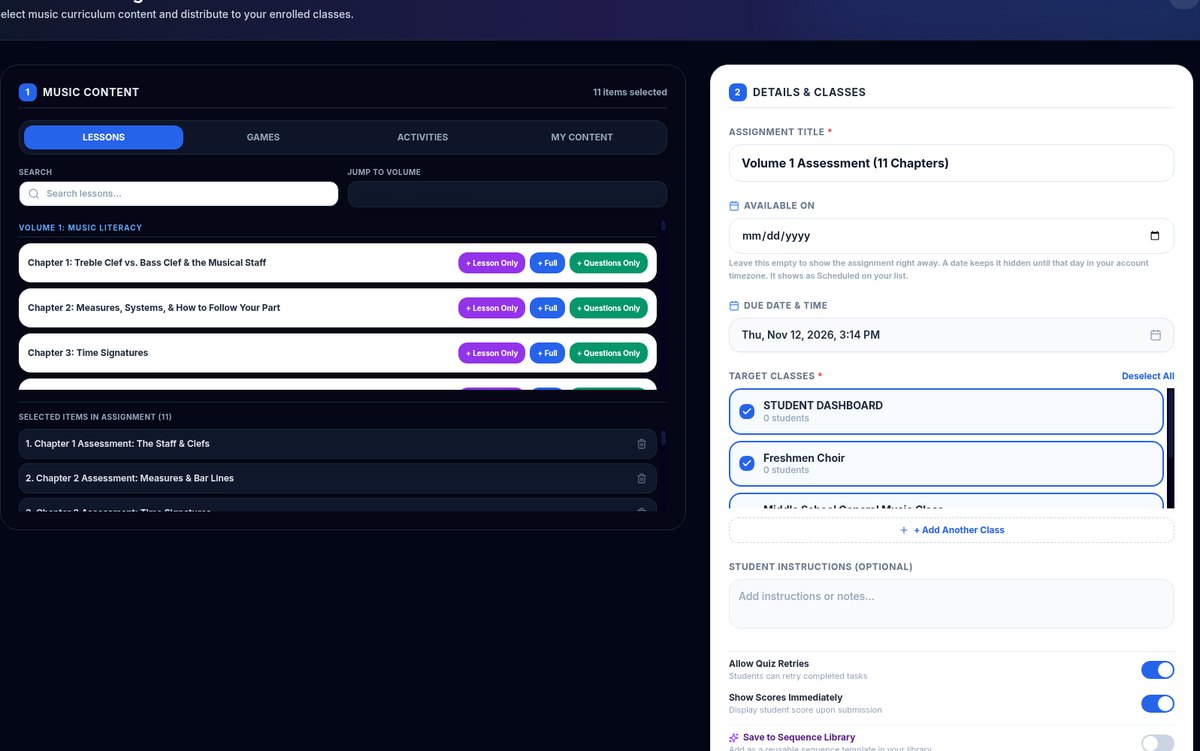
Return to the instrument or voice after the follow-up. For a meter check, clap and play the phrase. For key signatures, point to an affected note before playing. For score reading, follow the correct staff through the next system. The quiz informs that next step; it does not replace it.
Frequently Asked Questions
How often should a middle school ensemble take a theory quiz?
Use a short check when you need information to plan the next lesson. That might be after one chapter or after several related lessons. Three Minute Theory's chapter assessments make a narrow check possible without requiring a full-volume test every time.
Can I assess without a device for every student?
Yes. Use Project Quiz and have students record answers individually on paper or whiteboards. Keep the game discussion separate from the individual response you collect. If you assign a digital assessment, plan device access for each student who needs to complete it.
Does every TMT volume have the same written quiz bank?
No. The regular chapter written assessments cover Volumes 1 to 9. The Sight Reading Volume's written assessments are still in development, and bonus Chapter 101 uses a different review path. Check the chapter's available controls rather than assuming every lesson has the same assessment options.
Can TMT AI replace checking the answer key?
No. Treat its Quiz Generator output as a draft. Read every item, verify the answer, and remove material you have not taught. Use the ready-made chapter bank when it already matches your objective.
Keep the Check Smaller Than the Rehearsal
Pick one skill, teach it with its Three Minute Theory chapter, practice with a review game, and collect answers you can use. For a wider plan, see the music theory curriculum map and music theory bell ringers.
See monthly and yearly plans at ThreeMinuteTheory.com. For a separate sight-reading practice tool, explore SightReadQuest, and find more teaching resources at MatthewGawronski.com.